
Browsing Category

Product Marketing

Slide Week: Market Research is Work, A Process and Changing

There are numerous reasons to do research, but hopefully you are pursuing a research initiative to better understand what is happening in the marketplace. To that end, the purpose of researching a market is for understanding, not to prove an idea you have. Ideas should come from your research, but too often marketers go into research mode to prove themselves right, their peers wrong or some other equally as jaundiced purpose. Research is about discovery and of course you frame your research in context of a hypothesis, but too often we develop a research framework that ONLY proves the hypothesis. If our goal is to go to prove a point we might pursue limited inputs, sources, survey samples or other put some other constraint one the effort that proves a concept we want to move forward and just satisfies some corporate mandate to do research as part of your checklist or product approval process.

I personally have done a whole bunch of market research that has proved my original idea wrong and I’m cool with that. The reason I’m cool with putting a bunch of work in is that if I hadn’t I just might have wasted millions of development resources and marketing expense pursuing ego based research, rather than striving to understand market facts. This presentation posits not only the orderly way to structure the effort, but how intangibles are increasingly more important in some markets, ok maybe all markets, which requires us to better understand context and culture in our research activities.

Slide Week: The Dark Art of User Interface Design

UI’s can be critical in successful conversion of folks on your website and not all designers have the best intentions and allow for choice as this presentation outlines. Instead some UI designers prey on mis-clicks and the order of operations/presentation of complex forms and alike to get you on their mailing list or worst yet, get you into a transaction which is not as easy to get out of. This presentation provides insight into design elements that once we know about them, we are all better off.  Wouldn’t be great if there were standards around promotions, opting in and other conversion related activities?

Harry Brignull is all about good design and I’m on board with that.   Harry writes @ www.90percentofeverything.com

Slide Week: A Brief History of Open Source

Open source has apparently been around for 35 yrs according to this presentation.  There is no doubt how open source availability has changed the economics of enterprise software and helped fuel the growth of the cloud and this history of open source is very helpful to better understand how we got to where we are today in software. Many thanks to Francois Marier for putting this presentation which puts open source in a historical context.

Social Mediocre

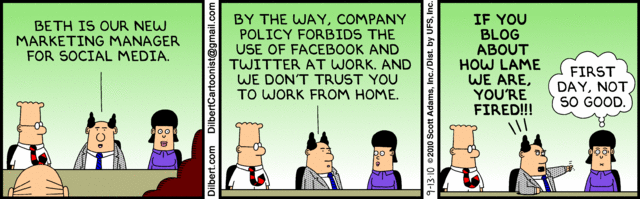
While this Dilbert strip is supposed to be fiction, I suspect it’s more real for some folks than it should be.  Social isn’t something you can do half way, you need to empower/trust your team members to get out into the marketplace to actively participate and learn from the people in the market.  It’s not just a marketing exercise either, you need to ask yourself additional questions and help the rest of the organization to support your products in the marketplace to improve traction from a new sales perspective and to increase the quality of service you deliver.  The questions I start with are:

  • How is sales using social media to better understand their prospects?
  • How is support using social to improve service delivery, knowledge of our customers business and their own processes?
  • How can other parts of the organization use social?
  • What can Finance, Professional Services, Development and QA do  to improve how they perform their craft and improve the customer experience?

Social Media isn’t just something for marketing, it’s something the whole organization need to embrace to better serve the market.  The emergence of the social organization is not a trend, it’s a competitive requirement.