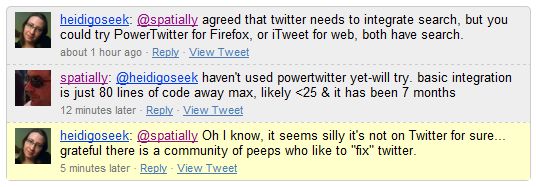
The names and questions that we get as a Product Manager are all other place from a title and role perspective. However; answering the “just what is that you do again?” or the confirmations of what I do “Oh, you’re like a project manager, right?” are equally not as fun, which is something most Product Managers have to endure throughout their career.
So we all end up describing what we do in non-traditional job descriptions, which may resonate with folks. Doubt it? Take a look at the tweets from ProductCampBoston.
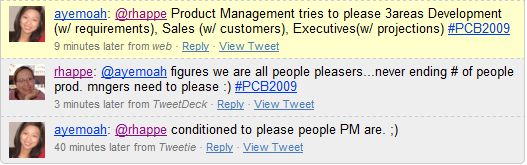
I’ve never considered myself a people pleaser, but corporate politician or favor trader works, which is not inconsistent with the Tweets above. Ultimately the activities, ownership and accountability for PM’s is a difficult thing when a company has all 4 of the PM’s types – Product Managers, Product Marketing, Project Managers and Program Managers. On any given product, project or initiative all 4 can be involved and ownership can be difficult to discern and each may have some level of conflicting goals/motivations, but that is have the fun of being a PM. So I’ve been stuck on the 4 PM concept for like 2 weeks since I talked to a friend:
“We started a project the other day and it has a Project Manager, 2 Product Managers and 1 Product Marketing person and my boss is more worried about how the PMO office is going to report on it, rather than if we are doing the right thing” – Annoyed Program Manager.
Oh the right thing! The right thing varies by job description and role, ownership, influence and visibility across the business. So while I haven’t taken much issue with being introduced as a project manager, program manager or a product manager to clients, it’s mainly because in any given situation a product manager can be 1 or all of the roles. I do know however that if dialed in correctly having all 4 roles can deliver good things for a business and a product. So figuring out what each person does is an important thing and may vary from project to project and release to release.

So I thought it might be a good time to put to paper a delta analysis of what a PM does of each iteration.
Project Manager: The Gantt Will Set You Free
Ever since Henry Gantt pioneered the controls, constructs and made a pretty chart with critical path diamonds, Project Managers (PM) have objectively been presenting slip risk, providing two sentence summaries and yellow/red/green bubbles to management teams everywhere. Have MS Project can travel! The reporting and task management realities of development, launches and organizational readiness require an attention to detail, lack of emotional investment and organizational balance which typically isn’t a core value for a Product Manager (PM).
The successful interaction of all PM’s with the Project Office is an imperative, since it is typically an agnostic group which is solely accountable for schedules, costs and trusted objectivity. The best models are to have this as a standalone group. Not all organizations have this type of functional independence, but they should. I had a friend who once had the PMO in his PM group and let me tell you, that is a completely unfair organizational alignment for development and support, but a makes for a pretty cool Product Management time.

Product Management: Nebulous Interactions and Priority Juggling
While there is no patron saint of Product Management (PM) like Gantt for Project Managers, we do however have Dilbert and I’m OK with that. I’m sure there is some developer somewhere is going to say Dilbert is theirs, but that just part of the life as a Product Manager.
Product Management is different in each organization, with different title lengths and varying levels of P&L influence/accountability. Some are business owners and others manage requirements – some do all, while the common theme exist “You have to keep things going right way and manage priorities”. PM’s are responsible for optimizing the cross functional interfaces, customer value and competitiveness of their product in the marketplace and that creates a bunch of Dilbert moments. PM’s just dance around the organization and try to make things work. In the more technical organizations these folks are constantly managing the delivery of IP to Product.

Program Manager: Strategic Managers of Stuff
Program Managers have the DNA of both the previously evaluated PM’s, not so much Product Marketing folk tho. These are link Project Management Ninja or pattern a matching Product Manager of strategic things. Essentially a corporate tattletale of cross project collisions and the celebratory target for things that randomly align. This is a great gig for project managers and product managers alike – especially if you get organizational resource influence. Actually it could quite possibly be a really good gig with the right company: organization switching, cross product reporting and interfacing with strategic clients/executives. There is significant risk of incremental sport coat requirements in this role.
While there are at least 1000 product managers at Microsoft, who each admittedly have a tough time articulating their role in the Borg, the MSFT program managers readily admit that “Dude – I got a sweet gig!” and have a REALLY hard time explaining what they do. It might help just to understand the difference in a program and a project:
1. A project is unique and is of definite duration. A program is ongoing and implemented within a business to consistently achieve certain results for the business. A project is designed to deliver an output or deliverable and its success will be in terms of delivering the right output at the right time and to the right cost.
2. Program management includes management of projects which, together, improve the performance of the organization. A program’s success will be measured in terms of benefits.
3. Benefits are the measures of improvement of an organization and might include increased income, increased profits, decreased costs, reduced wastage or environmental damage, more satisfied customers. In central or local government organizations, benefits might include providing a better service to the community.
4. In the course of achieving required results, business programs will normally understand related business constraints and determine the processes required to achieve results based on resources allocated. Improvement of processes is a continuous operation that very much contrasts a program from a project.
5. At the lowest level project managers co-ordinate individual projects. They are overseen by the program manager who accounts to the program sponsor (or board).
I kinda see it like being a “cross-thing” corporate gardener and really similar to the other PM’s – the only difference is scope and lack of titles about director.

Product Marketing: Go to Market Magic
Product Managers (PM), not unlike program managers, are responsible for the random alignment of product goals and revenue optimization. The right story, the right capabilities and the marketing mix are essentially the domain of Product Marketing folk. Moderately good excel and PowerPoint skills are essential. These folks are the organizational sanity check on a given product or set of products. Sales enablement, product level brand connection and consumable stories which drives revenue and reduces cost. For most organization’s being a PM is like being a Product Manager minus product delivery.

No matter where your company is in the 4PM model, all you need is a little trust and experience to make it work. Detailed job descriptions help too, especially if you have all four.
Maybe I should have just tried to explain the roles by the core apps they use:
- MSFT Project + PowerPoint + Intranet Project Status Site = Project Manager
- PowerPoint + Email = Program Manager
- PowerPoint + Email + Excel + Software Lifecycle App = Product Manager
- PowerPoint + Email + Excel + Adobe = Product Marketing
New Here?
In general I blog about technology, music and marketing. Not necessarily in that order. Add me to your reader or subscribe view email.
cheers! ~jon