
Browsing Category

Product Marketing

Principles: Shading strategy, execution and interactions

prin·ci·ple [prin-suh-puhl] –noun

1. an accepted or professed rule of action or conduct: a person of good moral principles.
2. a fundamental, primary, or general law or truth from which others are derived: the principles of modern physics.
3. a fundamental doctrine or tenet; a distinctive ruling opinion: the principles of the Stoics.
4. principles, a personal or specific basis of conduct or management: to adhere to one’s principles; a kindergarten run on modern principles.
5. guiding sense of the requirements and obligations of right conduct: a person of principle.
6. an adopted rule or method for application in action: a working principle for general use.
7. a rule or law exemplified in natural phenomena, the construction or operation of a machine, the working of a system, or the like: the principle of capillary attraction.
8. the method of formation, operation, or procedure exhibited in a given case: a community organized on the patriarchal principle.
9. a determining characteristic of something; essential quality.
10. an originating or actuating agency or force: growth is the principle of life.
11. an actuating agency in the mind or character, as an instinct, faculty, or natural tendency: the principles of human behavior.
12. Chemistry. a constituent of a substance, esp. one giving to it some distinctive quality or effect.
13. Obsolete. beginning or commencement.

—Idioms
14. in principle, in essence or substance; fundamentally: to accept a plan in principle.
15. on principle,
a. according to personal rules for right conduct; as a matter of moral principle: He refused on principle to agree to the terms of the treaty.
b. according to a fixed rule, method, or practice: He drank hot milk every night on principle.

The funny thing about principles is that not only is the construct so nuanced that it supports 15 different dictionary use cases, but we often forget iT shades most daily actions. I was reminded of this throughout the week based on three different interactions within multiple settings – professional, social and familial. The trifecta of situational proof points that principles could be seen as an individual’ personal acceptable use policy.

Each situation for each participant is shaded by not only personal experience/biases, but constrained to the context of one’s principles. A friend has told me time and time again, your “world view” impacts your reactions and others reactions to YOU. For example, my view of productivity and follow up is not the same as others or vice versa. which while circular logic is the recursive spiral many interactions get into because of core DNA differences with folks. At times you just can’t connect your idea, emotions or actions toward what may or may not be common goals. Ultimately, how does an individual internalize a strategy, a brand or an action plan in the marketplace or in a cohort group is often the common thread of miscommunication between folks, as least that’s my lesson of the week around principles.

To effectively lead, manage or interact this is a baseline reality is often forgotten and overlooked, MYSELF included. I find myself not asking enough questions, but instead interpreting reactions and actions within how I would see/feel on a given topic which is more of an anchor than way to move forward and drive change. So my personal and career challenge to myself of week is to use my ears more than my mouth and to ask questions as to why something isn’t as effective as I thought it would be, rather than to make assumptions based on my own understanding/filter.

I think with this approach then perhaps I can avoid the pitfall of the best laid plans going awry. So now I think I have 101 things to be thankful for.

I really get excited when life hits you in the head with a blunt object and make you realize the best thing is that we are all different and bring different view, strategies and tactics.

For me it’s those situational reminders which provides clarity on things. I think I’ll read the 4 agreements again.

Dude – like social metrics, momentum and stuff

The launch of the latest interim board for Social Media Club has been an interesting thing. The traction has been pretty good and the numbers, while they may or may tie out in the press release to exactly 42 – they are directionally correct. So here is the “Social Media Dashboard” for the market launch:

  • 59 new members signed up since the press release
  • $2,000 in member revenue
  • 35+ comments of people wanting to be the 42nd interim board member, plus 7 private messages
  • Some folks think 41/42 are too many people for a board
  • A significant retort on Nuking the Fridge
  • Revitalized chapters and new requests to form chapters

With the email distribution of the “dashboard”, some of the board members have started their lessons learned phase and improvement iteration already. I suspect each member in their own way is executing something in the context of the “do goood” governance model – posting, actioning feedback and identifying a path forward. This is starting to look like a business and just like a business this dashboard information is a limited and latent view of the ongoing evolution of the conversation around the new board.

The conversation is all over the place – pros and cons. I thought I would spend some time to provide a little context to the metrics and information above for those of you who haven’t decided to get involved YET or may never get involved.

Increased momentum

The release and follow up content is establishing an initial inertia which previously didn’t exist for the social club. More content the better -right? There is no such thing as bad publicity, so I encourage @AmandaChapel to crank up the “hyperbol-ic” satire machine and go. Afterall, it is all upside. Even the group’s lemonade solution of the press release miscount, “the search for member 42”, has been reasonably fruitful and hopefully folks that want to be on the board push it well beyond the 35+ comments of interest.

In general, volunteer groups need more members and the social media club go some in the past week. So it appears the formation of the interim group is building the membership and awareness consistent with it’s corporate speak goes.

Size Matters?

While the momentum math is a little fuzzy, if you consider all the tweets and board member posts is considerably larger than represented above and it appears to be how you size the impact of an event in social media, increasing the share of voice. Without a large interim group, the reach would have been less and board size provides for increased skills coverage and redundancy for task execution. The whole concept about the board is do the work, whatever that is. That’s where the board is going – task groups, execution plans and exits. To that end, I think the use of the term interim is the correct adjective for the noun, the board.

Upon a little reflection though, these headline numbers, while interesting, may not be actionable at this point. This mirrors some of Kelly Feller’s key messages on the importance of metrics, deliverables and transparency in business around social media. As a business guy, who blogs both as an individual and as a member of a corporation, I couldn’t agreement more. Even with Eloqua, Google Analytics and WordPress stats – tough stuff to establish an increases revenue R factor.

<aside> I think overtime social media will move post the transaction and ultimately may not be a demand generation engine at all. Wouldn’t it be helpful is there was a standard based model/approach for social media metrics which could be generally accepted by businesses? </aside>

Metrics matter and is the biggest gap social media marketers have. Don’t get me wrong, metrics are available, but the one’s I’ve been watching for almost 2 years suggest that community is about customers, not prospects – at least in the B2B space which is where I exist.

If all you have is a hammer – everything is a nail.

Jumping the Shark?

So I clearly remember the jumping the shark episode from Happy Days and even recall thinking it was dumb when I saw it as a kid, the same with the Indy flying fridge, but I struggle to find a parallel to the board and based on these high level metrics this appears to be to be the general theme. That being said, putting Nukked the Fridge in the title does make for a killer headline. I think we have all seen enough copyblogger clones like “the 10 irrefutable laws of _________”, so I’m super groovey with the post on that level.

Delivering an ROI

The conversation is social media’s share of voice, old school PR – yuck.

The whole social media ecosystem centers on the key construct of conversation. A conversational approach  is essentially the key differentiator from a market approach for new media folk and consumers in the channel. Just to let you know, it isn’t that easy to define or to develop a business justification document against conversation as a deliverable.  I know – old school business – yuck.

Even the market metaphor is innately noisy. With increased adoption, diversity of voice and new use cases some of these things will work themselves out. The most interesting factor in impact is typically time oh but if only you could cube the future. Overtime the market participants we become more diverse in their focus, capabilities and the message will morph which will aid in developing more traditional business approaches on how to achieve a tangible benefit.

Diversity is a good thing. Ultimately, if there isn’t enough diversity in the social media conversation, then the risk is we’ll all continue to drink our own Kool-Aid. We’ll continue to distribute our Purplesaurus Rex on our blogs, friendfeeds and tweets with limited awareness, minimal credibility and acceptance. So perhaps the general goals of the Social Media Culb of awareness and adoption will help diversify the predominately “everything is cool, build it and they will come and rainbows and unicorns messaging platform”.

There is definitely the risk of the social media marketers to plateau as the deadhead equivalent of a marketer. At this point, the social media’s value prop is at best the revenue equivalent of “Kind grilled cheese & veggie pitas made with love for only a $1”, which trust me doesn’t scale and can’t be sustainable in the current energy market.

playlist>

On Blogging

This is a guest-post from Stephen Smith – small business conversation consultant, public speaker, and the editor of Productivity in Context where he teaches people how to use basic tools and simple practices for taking control of their workflow situation, practical ways of being more productive at work and at home.

These practices are designed to give you more time to do the things that matter to you!

Recently a friend of mine and newcomer to blogging had an inspiration for a thought-provoking post. He carefully crafted his message into three bullet points with clever details and thoughtful insights. Since he had been quite prolific recently, he post-dated the article to run three days out.

Then disaster struck…

A duplicate post!

A similar post was featured on an established blog with a large readership.

What to do?

Since two heads are better than one (even if one is a cabbage), he sent out a call for help on Twitter (where you get breaking news first!). Never fear, I told him, this is what you do:

  1. Run the post right away, with two quick changes:
    • Add a link to the other post at the end of your article. It never hurts to acknowledge the other writers, and it definitely helps to get you noticed. Also, by pointing to the similar post, you can emphasize the differences and not look like you are hiding behind a copy-cat post.
    • Re-arrange your article to highlight the differences. My friend had written his post from a slightly different perspective than the bigger blogger. This meant that by simply moving some paragraphs around he could leave his readers with a much different mindset at the conclusion of the article. Then, by linking to the similar post, the interested reader could go and see the same topic from a completely different point-of-view.
  2. Send an e-mail to the author of the first post and introduce yourself. Let them know that you wrote a similar piece on that topic the same day, but with a different slant. Don’t ask for a link, but provide a link to your post in the e-mail. Perhaps you get a link, perhaps you don’t. In any case you have planted the seeds of a relationship.
  3. Subscribe to that blogger, so you can keep an eye on their interests and post-topics. This will help you avoid duplicate postings in the future, again, to avoid looking like a copy-cat.

The results?

The post was a success, and the final version, if I say so myself, was much better than the bigger blog’s version. Perhaps it had to do with the re-arranging, or perhaps just because a little more thought went into it. Now, I expect some of you might be saying to yourself, “Yikes, this happens to me all the time!“. Well, now you have a tool set for dealing with the situation.

On the other hand, some of you may be saying, “This never happens to me, my niche is too narrow/broad/non-controversial/etc. How can this help me?” I will tell you how.

When you write a new post, one that you really like, ask yourself this question:

How would [insert name of favorite blogger] write this post?

Think on that, then follow step 1.2, above. Re-arrange your post so that it approaches the topic from a different angle, and ends with a strong, non-[favorite blogger]-like conclusion. This is a powerful method for new bloggers to find their voice.

For those same new bloggers, I would also recommend following step 2, above, also. By contacting [your favorite blogger] you can nurture the relationship and foster communication. Let them know that you thought about how they would approach that particular topic as you were writing the post in order to gain a clearer understanding, and transmit it to your readers.

Again, don’t ask for anything but a comment. Just provide the post or an excerpt, and a link to it so they can leave a comment, and be sure to reply when they do comment.

Any questions? Please feel free to e-mail me via stephen at hdbizblog dot com.

Social Media Club Hits the Accelerator

With the recent press release from the Social Media Club, everyone is off and running! A new board and new opportunity. So I’ve clearly gotten myself over my head again, looking for some input…. It’s not like being over my head it’s unfamiliar space for me. After my post on the Social Media Club’s execution, I’ve had a flurry of activity around here. After the dust has settled, I have now committed to figuring some stuff out and doing a little effort. Oh what crazy stuff comes from truthiness. Great opportunity, is my take and an interesting process to boot.

After several interactions and a thoughtful discussion with Chris, I’m back to doing standards work, but in the context of Social Media. Chris and I rambled for a couple of minutes on the phone, talked around some my volunteer work in standards and industry groups (X12, VICS, NEECOM, OAGi, RosettaNet and then UCC, now GS1) and shared interest which apparently gave me some street cred. So with this somewhat trivial and completely unverified experience, I’m now able to “officially” allocate some time to the group. The trust economy is indeed a strange thing.

Kinda of refreshing – add value where you can. I guess membership wasn’t a bad idea and yes the t-shirt is great!

The evidently egalitarian approach to this club is fairly refreshing. An interim group to drive the next iteration of Social Media Club was kicked off this week. The group is 42 folks with seemingly diverse skill sets, seems a little big I know. The benefit of this approach is a highly redundant skills architecture to help scale the organization, a service oriented architecture for the organizations. The loosely couple governance model is constrained to a single rule set/theme – “do good for SMC”. In near real-time the group had a list server, press release draft, a wiki and a request for research.

Do The Work

Volunteer organizations are interesting entities – passion, skills and no shortage of things to do to be successful. Same thing at SMC. Every organization I’ve ever engaged in since I was young democrat had more work to go around than folks. So in an effort to start doing the work, I thought I would kick off my participation to better understand Identity.

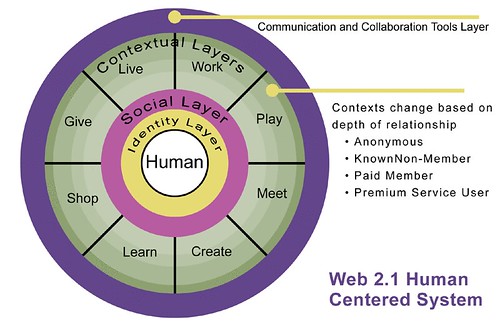
Social media is a changing landscape where personality, historical actions and group membership/brand association continue to impact the individual and identity. Below is a piece that Chris did a while back to help thinking about how social media and identity are innately evolving or devolving in lock step.

Fractured identity and the limited ability to aggregate access is becoming increasingly laborious set of activities for me at least. Platform fatigue, technology emergence or context changes impact where and how an individual participates, so data portability could be considered important.. That being said, it may not be the priority to focus on which would better enable adoption.

So in the interest of loosely defined research, I am lookin for a little help from my friends. What should be highest priority area of interest in standards alignment/adoption for Social Media Club? Is there another theme or standard which would return significant value to the over all community?

Here is the shortlist:

So let’s prioritize and do the work.

Comment, post or tweet.

If you post your ideas, let me know with a comment or use SMCBOARD as a tag for your post.