
Browsing Category

Product Marketing

Marketing is Geography

So this post has been sitting in my drafts folder for quite some time and I thought I was time to let it free from the dreaded draft existence it’s had for a while. The biggest challenge this the topic is it can go anywhere, no pun intended. With most marketing leaving the landed consumer experience, how can geography be related to marketing. The simplest way to look at it is sales and how to get a meaningful ROI from your marketing dollars – traditional and social.   Where are you selling stuff?  Where are you trying to sell?  What are the barriers to success in a given region?

Let’s face it – some patches have higher transaction rates than others and you can only effectively cover N% of the market at any given time based on resource capacity so it might not be that much of a stretch that sales execution/focus is often geographic.  Anecdotally, that’s probably why most businesses carry a geographic sales orientation, which Marketers need to be able to understand and how to best support tactical execution in focused geographies.  Another way to link geography is that Place(ment) is one of the 4 P’s of the Marketing Mix?

Geo based Business Development

So why is sales based approach a reasonable way to validate that marketing is geography? It’s the transactions – when people give you money for stuff it is a great event to look at to see if there are relationship. What do we know about transactions?

Every transaction has a location. Every business seeking transactions has access and capacity constraints which require some mechanism for the prioritization of opportunity pursuit, new to old – small to large. Since place is an inherent attribute of a transaction, an organization’s access/site and where their resources are/situation, it might make sense. Effective corporate marketing is understanding your company’s site and situation.

Businesses have place as a core attribute – a central location/site from where transactions are managed and pursued.  A business’ location typically provides for a focus on their immediate geography – less travel/cost, more likely to have a personal relationship and able to play the local card. This assertion assumes that you have an actual good to sell – software, hot sauce or widget.  This sweeping generalization doesn’t apply to an indpendant consultant type since they can travel anywhere and support any single engagement, so long as there is capacity and support from a schedule perspective.  To that end, let’s just constrain this discussion to businesses where labor bound service delivery or unused capacity isn’t reality, so the rest of this piece may not resonate with social media experts.

..so with that particular constraint in place…

As you look at the growth of a company, the majority of early revenues are geographically bounded by where you can get to in a day on a train or car, with some airplane based outliers or small phone based/online transactions.  Just a gravity model…

Gravity models are used in various social sciences to predict and describe certain behaviors that mimic gravitational interaction as described in Isaac Newton‘s law of gravity. Generally, the social science models contain some elements of mass and distance, which lends them to the metaphor of physical gravity.
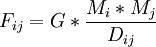
F_{ij} = G * \frac{M_i * M_j}{D_{ij}}

Geographic management constructs are common place for sales and marketing folks.  Conceptual sales coverage is a key attribute for sales leaders to manage and lowering the the cost of transaction is the domain of marketing. Early stage companies traditionally focused most of the marketing locally and regionally, outside of trade rags, trade shows in Vegas or niche online communities.  Marketing’s focus can transition outside of a localized place with a single win of a national account. If you can embedd your product in a national value chain then a spatial transition takes place for marketers which allows them to abandon the more localized focus on place.

A kitschy way to look at it is you can displace place with space at the primary geo based demand focus if you have access to a significant value chain without much effort.  Space also supports traditional gravity transactional models, but the space oriented approach isn’t about the location of the business.  The concentration of customers becomes the center, not the business or product.

Starting to feel like social media is just one big gravity model.

In a space based gravity model, marketers are empowered to leverage all the assets in the portfolio – sales coverage/capacity, customers and products.  Place based marketing is more about product, price and promotion.

A maturing business

As a business exits the hyper-local stage and expands beyond a region, not all geographies are created equal despite cliche’s such as “There is no bad patch, only bad sales people”. Alas, that just isn’t true.

Certain geographies have the right industries, median household income or other attributes such as weather or infrastructure which drive the demand for a given product.   Another example, a company sells software for managing the inventory of containers for large ports, there are probably only 6 or 8 real geographic opportunities. If this company started in NYC, they would probably expand south to Newport News, Savannah or New Orleans or to west with LA or Seattle.  Not too complicated.   Even if you latch on to a huge value chain you may stay extremely regional, think retail – if you win Menard’s or Mejier you have a horribly Midwestern distribution and transaction model for the most part.  In social media or a spatial model, you might not use Facebook to sell a NASCAR beer can sculpture – myspace is probably best.

Back to Marketing

So if a business’ growth could easily be based on a gravity model, then marketers as geographers need to support the growth with a focused plan to extend the reach of a company and their products.  So you have to look at all the 4 P’s and start prioritizing investment of the marketing to support both space and place.

Boundaries for Marketing Investment

So if geography influences growth, success and viability in a market, then how do you take a regional approach and transition into marketing into larger geographies or spaces?  Customer clusters and their value chains is the easiest way to extend. Let your transactions be your marketing compass.

Overtime natural geographic clusters or affinity based spaces develop based on sales execution and/or customer communities, not unlike the initial gravity model which often creates a cluster in a region or locality where a company was founded.

I guess it just comes down to the right marketing mix in the end.  Can a coordinated social media initiative allow an organization to not only transition from place to place from a transaction perspective, but also to support space based interactions which directly engage consumers where they congregate?

So perhaps Social Media can save the world or it might just minimally allow a widget purveyor access and coverage of markets which previously could not be accomplished with a total place based geographic market focus.

So I guess this wasn’t more than observations which represent the shameless propogation of the importance of geography or social media, you pick. Feel free to substitute social media is geography as the title.

Social Media Can Save The Planet

This post will clearly go all over the place, but it’s probably the only way to approximate “truth in headlining” with the post. After surveying things I’ve been writing on to help refine the blog, I’ve decided that sustainability of business practices is something I want to focus on going forward and I have been struggle for a headline for almost a week. Unfortunately I thought of this overly agressive headline while doing cocktails at the Cluetrain Event and stated it out loud as a transition piece I was going to do, so here we are team.

Sometimes doing what you say you’re going to do is tough, I actually ended up living in Guatemala for a while because of another casual public comment in grad school. In all fairness to my Dad, he never said having a set of core values was all rainbow and unicorns. The good with the bad I guess.

Green Washing Social Media

With the increased public declaration of environmental virtues by corporations, social media initiatives/projects can easily attach to these ever growing budget line items for the Global 2000. Potentially the transition from a pure play marketing opportunity to a core business requirement to remain competitive in the marketplace could be found in the green space. Investment in sustainable business practices ultimately lowers cost and improves effectiveness throughout the entire value chain. Social media can help deliver on these discreet business needs through network enabled communications and engagement.   Corporate green washing could be a good thing for social media.

Social media provides greening opportunity on many fronts for business not just deployment of social media by non-profit organizations. The customer/prospect engagement model of social media represents a paper free and transportation light alternatives for business to generate awareness and reduces friction in customer relationship management.

So there has been a considerable interest around a twitter account from Popeye’s Chicken and the positive feedback is certainly merited, but might also represent a paper free event management strategy. I normally don’t think about Popeye’s outside of Hartfield while I’m running for a plane and I now I’m somehow interested in an office chicken comparison event thanks to Twitter. What an interesting narrowcast event with zero cost and has definitely improved the brand’s visibility. Through network based interactions and social media tools Popeye’s has provided me access to an event I previously hadn’t been aware of.

As for a less effective and material rich comparison, I recently received 4 heavy stock post cards from IBM for an event I have zero interest in participating in. Not only did they hit me 4 times there was also a pile of at least another 50 for former employees on the counter for folks who had worked there for 5 years. I can’t even remember the event topic, but I do have the concept of wasteful in my head. With wasted materials and excess transportation of perhaps as many of 100 poorly target pieces to a single building or as much as 150,000 pieces globally from a single event it appears Marketing’s contribution to the benefits achieved in IBM’s annual environmental report could be elevated with social media in out years. That’s a whole lot of poorly target paper consumption and marketing spend which could roll up positively into the annual report.

Acknowledging the scale delta in these examples of a network based engagement models, each can be easily extrapolated into a meaningful metric around effectiveness, it’s just math. Quick logic indicates that free vs. not free scales in a reasonably linear fashion in network.

Sustainable Engagement: The Social Media ROI

So if you think of brand visibility and cost of delivery as key components of effective customer engagement, social media may be able to deliver an demonstrable ROI. Think about it, I truly haven’t thought of Popeye’s Chicken as a food stuff outside of the airport and definitely NEVER as a brand, but they have clearly created level of brand awareness which I did NOT get with the 4 duplicate cards from IBM. Leaving out fuzzy logic and brand math, it has some significant costs. Accountable math is not a requirement for social media or theoretical environmental models, but doesn’t mean it’s a bad idea to support.

ROI is about hard dollar reductions and any pull through opportunity to do a little green washing for the company is a good thing. Corporate values can be good things on several fronts.

Math is fairly straight forward: Production Costs + Postage. Simple approximated math says that IBM threw away over $20,000 from their media budget in a single mailing and chewed through a couple of carbon credits along away. I can’t imaging the annual impact, I think I get 2 mailers from IBM a month.

The Environmental Event Horizon for Social Media

So thanks to some random post on the LA Times blog and a Twitter account I’m more interested in some guys lunch event than a professionally planned IBM event – that’s an interesting parallel to ponder. Where organizations are looking to create awareness, social media is a great engagement model for marketers. The highly stylized IBM post card was completely ineffective. Social media provides for event management and broadcast messaging which has long worked in the geek community.

Personal proof point: Use of Twitter is how I ended up at the Cluetrain 10th anniversary event which was actually not the 10th anniversary since publication, but the I think the 9th is what I caught. Good thing mathematical accountability isn’t a social media core value.

Social media enablement of events is a great way to engage consumers to create awareness and provide reduced materials consumption which can easily be seen as green social media use case. Events are paper laden engagements and ripe with opportunity. From the initial outreach to conference schedules reduced consumption and costs have tangible business impact, plus we might get cooler stuff in the schwag bag if they saved on production costs. Technologies such as CVent have helped organizations to transition to paper free management, plus the added benefit of improved contact data quality since the users ultimately manage interest and level of participation themselves or get weeded out due to bounce backs. Social media’s green impact on conferences also extends to the virtual conference schedule.

A new platform from Cerado, Ventana, appears to also have a green value component on top of the social benefits of presence. The initial deliverables to the market included The Unofficial Pocket Guide for SXSW and the latest Official Supernova pocket guide this type of social media use case potentially become a preferred engagement model for event planners. This could ultimately eliminate paper agendas for some events while providing support for conference presence and communication not available with a 4X4 card stock badge insert.

Yup all over the place with this post- but this a simple example of achieving a competitive advantage in marketing which lowers cost and represents a great green washing opportunity for companies. Weak transitions and all – the conceptual hard dollar ROI model hopefully will get folks to thinking about how to help reduce the substitution of Influence for Investment when doing business cases for social media since it is the more generally acceptable use of the “I” in such conversations.

Dozens, Hundrends and Thousands OH MY!

I was talking to some friends of mine the other day and pondering what I should do here on this blog, mainly for input, since I can’t seem to figure it out myself.   Ultimately I find myself continuously in search of an original idea – not a whole lot of those out there these days, if any. It’s not so much the amount of available content, as it is the amount of non-original content centered on the modest number of content opportunities which exist. So I’ve been on this particular task for a couple of weeks since I realized that I want to participate online differently – specifically on a more personal level.

The main reason for the discussion in general, was my current ability to scale. I’m personally finding it difficult to scale with quality. In general, I think social media has a scale issue, not just from a technology framework perspective, but also as you focus on it as a topic theme. I think in general most topics/areas of focus have content scale issues, but the issue in social media is more acute.

A quick content analysis of key folks appears to validate that there are just a good deal on non-events and events which are leveraged to go back to the bag of tricks and highlight a key concept. Not a bad thing, in fact upon review some of the best writers in the social media space are effectively recycling content every 3-6 months in context of the latest Twitter outage or which new platform is where the cool kids should hang out at.

Back to the task…

Fundamentally how to scale a set of activities is always an interesting thought experiment and made for an interesting afternoon for the group. We circled the topic for a while and I paused to check twitter – glad I did. Wouldn’t ya know – the Gods of the Twitterverse presented a series of tweets by Amanda Chapel in the stream which addressed the scale issue. I have to paraphrase the tweet in question with over 140 characters, since the back function is disabled due to Twitter “stressing out”/service issues.

The cost of obtaining a customer/the profitability of the initial transaction is greatly diluted by the cost of service delivery over time. The delivery of customer service doesn’t scale.

True Enough! Sales transactions are the easy things for the most part of any initiative. We actually discussed this tweet for a while in and out of the context of blogging. A very productive exchange – each had their personal insights on the topic with a mix of varying industry experiences, company sizes and diverse set of current roles: operational, strategic and creative. So this one cat offers up the following:

Technology businesses are aren’t about the transactions, but the repeatable transactions and supportability of the revenue. Anyone can sell something to dozens, some folks can sell to hundreds, but the market leaders can sell AND support 1000’s.

So I’ve realized I’ve encountered a scale issue with how I’m participating online and I’ve seen a great number of businesses which have the same issues. Great ideas, great product, crazy transactional revenues, but no ability to scale the business. With the general realization/acceptance that blogging is no different, I’ll contiue my gedankenexperiment on focusing my content, but at least I have 3 questions I’m going to work:

  1. What content do I consume and where do I participate online? Quick quick scan indicates technology, people & the environment.
  2. What passions do I have? Family, politics, education and science.
  3. Where are there 1000’s? Where are there 1000’s of things to track? 1000’s of interested people?

Ideas?

Full Disclosure – Bad spellers untie

Since there are a considerably more readers these days, I thought I would piece together a thanks for stopping by piece, but got distracted with this email. I got a slideshare notification on someone putting a pitch in a group, so I thought I would I’ll look at the preso again. Glad I did – not only did I get to reminisce on the salad days when I had more time. I also got to find out I have a spelling error.

So now I have a topic of sorts – bad spelling and slides. At the end of the day – I haven’t been able to fix the error so it will live on the interweb forever. While I will admit an error, I’m not going to let you know exactly where the error is. C’mon – transparency can only go so far. (Hint: I before E, except in words like neighbor or their.)

On a technology note, I think slideshare is one of the more interesting widgets available for blogs. It offers something more visual for my blog and it is within my skill set.

So can look for the error or look at some other folks slides on slideshare.net if you haven’t used slideshare before.

More Recent Slides

Experimental Slides

So there are probably spelling errors in a couple. 😉