Browsing Category

Product Marketing

Human Intervention: markets in the making

So I spent some time understanding a little more the impact of social media over the holidays, basically in response to the online norm piece and a comment on art from gapingvoid guy, [tag]Hugh MacLeod[/tag].   People who interact online can impact online markets and untimately offline concerns as well.  O’Reilly had a [tag]Bill Janeway[/tag], from [tag]investment banking[/tag] firm [tag]Warburg Pincus[/tag], quote on the [tag]Money:Tech[/tag] conference which is fairly relevant in context of human interaction’s impact on financial activity:

The timeliness of this Conference is NOT only because “web 2.0” technologies and business models have reached critical mass in the financial markets. It is also because, as driven by the web more generally, the frontier between human and machine-decision making has become radically problematic. First, quantitative approaches in trading, pricing, valuation, asset definition vastly expanded the domain for machine decision-making. But then the humans struck back, by refusing to act like the mindless molecules that the models driving machine decision-making required. The self-reflective, behavioral attributes of human market participants is now driving back that frontier, requiring innovations in every aspect of financial market processes, beginning with techniques of risk measurement and risk management. When price is an inverse function of [tag]liquidity[/tag] and liquidity is an inverse function of price certainty, the recursive loop can only be broken by human intervention and action

Wow – what a mouthful and insightful – people impact markets. The significant investment in optimized algorythm based business models online may have a challenger – human interaction as it relates to online advertising.

Changed search models, content availability and pervasive shared content may ultimately make Feedburner’s (Google) adverpublishing platform which best serves as a sliver markets to a high value market channel at some point in the future?   While not necessarily the mainstream population, active online human decision makers continue to collectively impact markets, one might say communities.   Facebook, Twitter or others represent segments of market influencers and makers. Most [tag]Facebook valuation[/tag] discussions all essentially acknowledge a significant market segmentation asset.

Communities as Market Makers

The current underpinnings of the global social media infrastructure (Xobni, [tag]Utterz[/tag], Twitter, [tag]Plaxo[/tag] [tag]LinkedIn[/tag], [tag]Flickr[/tag], [tag]Flock[/tag]…) are establishing market definitions, definitions of buyer classes in their highly attributed/user extended data model.   So that begets the question as to how does a collective commonality define a market? Are there bookmark markets? Blog markets? “Group” Markets?

It’s reasonable to infer this is in fact the case. Sites/Platforms such a Digg,  writing cabals creating content and individuals bring together friends and randoms around a common set of attributes which should they sustain overtime may in fact create micro-markets. Not a believer?  Go to Gizmodo – That IS a Gizmodo market.

Sure advertising is inherently audience biased and to that end the delivery vehicle has just changed, but can the vehicles actually begin to deliver value add services – access to branded public information, focusedcontent and web service community tools across an interoperable network.  Imagine it – share attributes (friends, content, services…) could be managed through a unified market based UI – the Facebook user who likes cooking, the Truemors reader who looks up his 401k balance on the truemors interface – there are all kinds of abstract concepts and extensions. Once the social media markets mature from their currently narrowly banded spiky reality, these may be the only advertising markets – community focused views of online commerce, communication and service consumption.

So now on to the the abstract thought to end the article.  Does an individual define the market or an individual’s relationships?  If it’s the latter, Facebook may be under valued and the usability race has begun!

Things I have already learned in 2008: Check Out Blog

So I’m one of those odd ducks that actually looks forward those moments when I run into one of those “I don’t/didn’t know moments” – these are opportunities, not moments to dodge. I’ve doing a bunch of random research the past couple of weeks and had only modest time to do anything with the holiday’s thrown in, but I’ve already have some interesting things I have actually already realized or learned in the past couple of days, but mainly I thought I would talk about the Wal-Mart blog.

Check Out Blog is an amazingly well written blog with an interesting set of characters. ( Go Rand! [tag]Sustainability[/tag] is good, I’ve been [tag]compact fluorescent[/tag] for years and not recycling is essentially a crime in Ann Arbor, so I got real good at it.) Man I wish it wasn’t a Wal-Mart blog, because I got a little jaded and told myself “try to give it a chance”. So I decided to dig into the authors because the authors look so happy – not unlike the Wal-Mart greeter. I’m confident that there was some be a Wal-Mart blogger contest which was only extended to buyers and merchandisers after reading their profiles, but the lady who checked me out late night in Alpharetta probably shouldn’t be a blogger.

As I continued to dig through profiles, I quickly learned, there has to be a ghostwriter somewhere in the mix, but that is not a bad thing – take Alex Cook‘s profile with the following statement:

In layman’s terms, I work with a group of professional buyers that are responsible for buying all the pc’s (and cool stuff that plugs into the PC’s) for the Wal-Mart stores in the U.S.

So as a technologist, I couldn’t think of keyboards and mice as cool things that plug into a computer, so I browsed walmart.com and indeed found “cool” things to plug into my PC, like the mouse below.

I agree, resting my hand on a picture of my family on holiday could be considered cool, providing I was put in a time machine and was able to plug it into my rad as hell 486 Hewlett Packard while scorching my way online at 14.4 with my new mouse resting on a mouse pad with a picture of my college dog Chumley. But the best bio is Tif’s.

Tifanie Van Laar

Author For Gaming


About Tifanie Van Laar

I am the [tag]video game software[/tag] buyer for Wal-Mart, but before starting this role, I did not own a single video game or [tag]video game platform[/tag]. Since that time, I have joined the legions of game players across the globe and proudly sit in the corner clicking away on my NDS while my boxer dogs, Makeda & Rohan, watch with disdain because I’m not paying attention to them. I have been a buyer with Wal-Mart for more than 8 years and have bought a vast array of items from movies to paint. I greatly enjoy my role with the company that harvested me out of the [tag]University of Arkansas[/tag] of which I am a very proud alumni….Woo Pig Sooie, Go Hogs!

Not only does she have an inner gamer, she likes football and was apparently harvested, like corn – ahh fall is such a fun time in Arkansas. All that is required for an all-in demographic win is a NASCAR reference, which oddly doesn’t exist on the blog – I searched. While the rules of blogging and the concept of transparency for corporate blogging might be fuzzy, outside of sustainability man, the personalities of the blog are just right. Kinda a Goldilocks approach to authors.

The Point of this Post

Wal-Mart has actually done a great job, despite my jabs at the authors. The team at Check Out have created a platform for collaboration, easily understood content and provides a human aspect to an otherwise less than human organization that used geographic information systems and analysis to destroy downtown Americana. As I read the profiles the other thing I notice was folks work their a long time – how many employers have folks with this type of tenure 7, 13, or 14 years? Can’t be a bad company when folks, like Danielle Pribbernow, “look forward to a long career” there and with a name like Pribbernow there has to be endless fun in meetings. “Ok now let’s plan for the next steps now, no I really mean now – like Pribbernow damn it!” Ok maybe there aren’t a bunch of things do with the name, but I like saying the name. Say it three times fast.

So kudo’s to WM for their efforts at Check Out, while I’m not sure I’m good with their assertion that all lanes are open, I’m definitely good with such a large company trying to engage their customers in a dialogue by understanding the following:

Know you audience – The most likely readers are the gamers, so produce content mainly for them. A great deal of folks who want to save the environment read blogs so put something out there for them. A targeted approach to extend the brand identity to be a more eco-friendly and Rand does that well, What is your PSP?

Don’t Overextend – They don’t try and be thought leaders, just factoid folks who don’t seem to sell that much, but provide information about the products. The type of stuff I might ask in a store from a Wal-Mart team member should I actually be able to locate one. IDEA: Put the blog on Kiosks in-store to help answer questions, locate products and take applications, multiple purposes will help prop up the ROI.

Social Media Rules? Not really, norms is a better concept

I continue to spend time thinking about the impact of social media, while I believe it IS the newest and increasingly most important marketing channel, a more effective way to understand market requirements and drive innovation, sometimes I think I’m not the average blog reader/user.

This rings home when I get caught twittering in the car or some other place and my wife says something like “how are your internet friends doing today” or if we are in public with others she just goes ruthless with something like “have you heard of twitter? It’s this weird voyeuristic way of pimping your blog and communicating with followers – this whole whole web 2.0 stuff is just a little too egotistical for me and God knows I need a bigger ego! On twitter they aren’t called friends – they’re followers – bring on the geek Kool-aid.” So while I cringe at these comments, I think she may be right and that’s not just because it makes my life easier to agree with her.

In the interest of full disclosure, most folks have no idea they are part of this whole phenomenon and do look at me a little strange when I start talking social media. Most have a myspace account, browse [tag]YouTube[/tag] and may have just abandoned [tag]LinkedIn[/tag] for this new thing – [tag]Facebook[/tag]. Most folks who use these communities are passive and don’t embrace them as those of us who are more or less geeks. So I went searching to better understand how Social media is being used and what is the expected mode of operations for an engaging community, so I started at Mukund’s blog and found a great set of additions to Chip Griffen’s post on Social Media rules and I couldn’t agree more with the following statement:

Several self proclaimed pundits of social media, claim many things that I tend to agree initially but on further evaluation, notice its not the reality.

There are three other observations from Chip which make me again re-evalute how I should start thinking about the use of blogs from a marketing perspective:

It Isn’t a Blog Without RSS. Go ask someone outside of the tight social media circle you play in and ask them if they use an RSS reader. If you don’t get a blank stare or a quizzical look, count it as a victory even when they say “no.” The fact of the matter is that RSS belongs to the uber-geek set.

It’s All About Conversation Not Messages. The word “conversation” has a very nice ring to it. It sounds egalitarian and idealistic, especially when applied to corporate marketing behavior. But ultimately social media campaigns are – and should be – about the message.

Audience is a Word of the Past. Somewhere between 1 and 10 percent of people who read blogs comment. It’s not a true conversation if more than 90% of the people just listen. What you have, friends, is an audience still. That’s not to say that new media isn’t more conversational than old media, but just as a small percentage of folks call radio talk shows or write letters to the editor, the same few comment on blogs. That means there’s still a vast audience to communicate to in a more traditional way.

While immutable truths of social media may not exist and I do agree that many in blogosphere create an overly cumbersome set of expectations on what is authentic and real, undoubtedly there are norms developing in the space. While I’m not sure blogging is a commerce driver, it is driving a new cultural reality which is well beyond the buzz word of community. As businesses engage/embrace social media it is important this new communication platform is used within an acceptable framework, which I look at as a set of norms – not just for the geeks and those who comment, but also for the passive reader who is there to consume knowledge. So the only norms I think I can identify so far are:

  • Relationships are not just a click away – This norm embraces the reality that as you participate in social media, add value and it will all work out in the end or not. It’s not enough to just throw up a video or have a big list of followers. Sarah Wurrey validates this cultural norm with the following comment on Chip’s post: “The rule I would toss out is the idea that you have to “follow back” everyone who follows you on Twitter. I got a bunch of new followers lately and followed them all back….and a good number of them don’t contribute anything I find all that useful or engaging”.
  • Activity does not equal anything – This norm represents a tenant which means just because you post a bunch or actively participate in a given community, doesn’t mean anything. This might just be something I’ve noticed, but Sarah’s comment above and the reality that social media is as much an art as anything – just like marketing in general, make me believe activity is just that – activity. I actually find myself increasingly ignoring content from “over posters”, as an aside I know Jeremiah is smart, but geesh can’t he figure out the whole tiled logo thing on twitter?
  • No one likes a lemming/search pimp – this is the general apathy that is evident with many blogs which are just out there because they have to be into this whole web 2.0 thing, most commonly seen in corporate blogs and those link love blogs which are basically a single sentence praising or denouncing a post looking for ad revenues. Let’s see how many keywords I can appeal to and let’s see what happens. Sometimes lack of comments actually means lack of influence and that’s good thing. It’s ok to be a link blog or to do link posts, but just be cool about it and own up to it. Not sure what I mean? See how it’s done right by Edward and the rest of the Ann Arbor cabal.

Maybe these aren’t norms, but at least they are my musings and how I’m starting to see this whole blog thing – a sub-culture which will continue to move towards the mainstream, but at this point it’s mainly a bunch of geeks with a set of expectations which may or may not be commonly held by the larger audience, which is the real opportunity in social media – the larger audience. Education, awareness and insights are emerging as key deliverables inside the 3 boundaries above which continue to help box in this whole social media thing. I know a shape with 3 sides is a triangle, but boxing in isn’t really about 4 sides – no really.

While I know I’m right about this geometry thing, I could be completely wrong about every other assertion which ultimately represents my preferential bias as a marketer, but I feel better now that I wrote this post.

Roadside Observations: Population moves and a sign of the times

So I was doing a little bit of travel over the holidays and got to see a good bit of the back roads country and survey roadside advertising. The quality, product mix and “vacancy rates” appeared to have changed from what I historically remember. Although I will say that promotional messaging for empty billboards is getting much better. The other interesting thing is the use of “shared space” appears to be up for billboards….

Billboards may be a bellwether for the state of the economy and represent a great part of the cultural landscape which I like to appreciate. I originally wrote myself a note on this topic last week, but was reminded of the concept by Vaguery on twitter, who in real life is Bill and blogs over @ Notional Slurry. Economic trends and perceptions of the economy impact individual, local and regional buying behaviors and how marketers appeal to buyers.

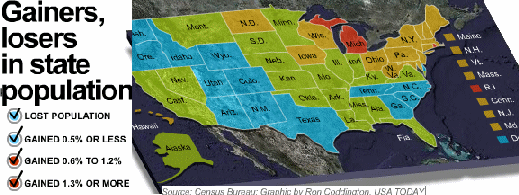
Vaguery’s tweet of “…considering the likelihood of any Michigander doing real five-figure cookery” seemed to align with billboards, data and articles I’ve been reading/seeing, such as the USA Today piece I read over my free continental breakfast the other day. So things are changing – spend patterns, the movement of people and general open market activities.

The USA article spoke of the current housing woes and how they impact population movement. “Michigan hard hit by cutbacks in the auto industry and other manufacturing sectors” has seen population decline and housing value declines ahead of the rest of the nation. This was unscientifically verified as I drove around and saw more for sale signs than I think I have ever seen.

At the most basic level, demographic changes impact market dynamics – specifically how people market and what they market.  With a more granular look at the population shift, by state, it becomes evident that Michigan and RI are seeing a different level of change than other markets.


With the change in the economy and population, the roadside marketing landscape has changed as well since general investment patterns change from all key constituents segments – government, national brands and local SMBs. This change appears to be visible in the current billboard mix being mainly casino oriented in Detroit – no longer automotive/manufacturing innovation related.   The overall billboard content also appears to be on a different level of creative quality as well, not just the type of advertiser. I was able to find the following billboard just outside Lansing in Portland, Michigan which is an example of the changing billboard landscape throughout Michigan.


I’m glad I’m not in billboard advertising with a weakening dollar, tempered consumer confidence and the apparent need for cheap pepper spray as a stocking stuffer.