Experience Is The Product
View more presentations from peterme.
Connecting consumers with a brand doesn’t just require good copy – it needs a competitive product.

Connecting consumers with a brand doesn’t just require good copy – it needs a competitive product.
Are you new around here? Spatially Relevant, not only is about sharing the things we find from cool people, but also sharing/identifying trends in marketing, branding and how product managers can change a business with technology, such as social media. Stick around and add the rss feed to your reader or follow on twitter. Now on to the article.
—
So it does takes all kinds to make the world go round. While I’m highly appreciative of funny stuff and understand the importance for marketers to make folks remember a brand, not sure Boost Mobile is taking the right angle. While the value based messaging of all in pricing is interesting, it is only interesting until you read the details of the monthly unlimited plan as of 3/15/09, which was downloaded from http://plans.boostmobile.com/pdf/english/monthlyunlimited.pdf.
So maybe an unlimited plan is what a person needs, but you better not travel much if you select Boost. Below is the coverage map, which looks more circa 1999 than the competitive market requirements for most cell phone providers.
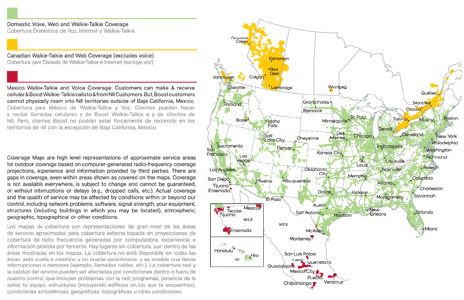
So as you drill in, the limited coverage, incremental fees and $1.29 per directory assistance calls appear to make the unlimited plan a little wrong, not unlike the “other carriers” referenced in their recent commercial series. So if you never leave your neighborhood, lose a phone number and have enough money on your account you are good to go! Oh Yeah – you money on your account, it appears Boost Mobile is some hybrid pre-pay plan thing to make it easier to manage the overage risk – no money no overage, simple. So if you factor in the account management overhead, limited coverage and that it cannot be used for “unreasonable use” this may not be the company for most people, especially people that read contracts.
Let’s explore the definition of unreasonable use -conference calls, placing call of abnormally long duration and atypical web use can get your account closed. Here’s details of the plan and unreasonable use:
$50 Monthly Unlimited Plan: Includes domestic voice calling, walkie-talkie, web, text messages, picture and MMS/Audio messages. International services incur additional charges. Text to 3rd parties to participate in promotions or other may result in add’l charges. Directory Assistance: Calls to all directory assistance numbers incur a charge of $1.29. Payments: Your monthly payment date will be the day of the month that you activate service on your phone; activation of service will occur when you have sufficient funds in your account to fulfill your monthly payment. Your payment must be made in full within 60 days of service interruption to resume service or your account and service will be cancelled. When your account is cancelled, you will lose all funds in your account balance and your Monthly Unlimited telephone number. A $10 reactivation fee will apply. If your service is suspended or terminated your payment date will be the day of the month that you reactivate service. Service activations on the last day of the month will always renew on the last day of the given month. Payments are made by adding funds to your account and your account balance must contain funds equal to or greater than the monthly payment amount no later than 11:59 PM the night of your monthly payment date or service may be interrupted due to non-payment. This account balance is decreased as monthly payments are due and services not included in the monthly plans are used. Your payment amount does not include incidentals, including, but not limited to, international calls, wireless entertainment and downloads. A nonzero Prepaid Credit Balance is required at all times for access to any Boost services, except 911 and Boost Customer Care. Your account balance cannot exceed $300. Other terms: Unlimited services only available on the Nextel National Network. Coverage not available everywhere. Offers not available in all markets/retail locations or for all phones. Prices, rates, taxes and fees are subject to change. Boost reserves the right to modify, extend or cancel offers at any time. Other restrictions apply. Visit boostmobile.com for details. UNLIMITED USE DOES NOT MEAN UNREASONABLE USE. To ensure that all customers have access to reliable services provided at a reasonable cost, you may not use our service in a manner that interferes with another Boost Mobile customer’s use of our service or disproportionally impacts Boost Mobile’s network resources. Prohibited Uses: Boost Monthly Unlimited services are provided solely for live dialogue between, and initiated by, two individuals for personal use and as otherwise described in this policy. Unlimited voice services may not be used for any other purposes, including, but not limited to, conference calling, monitoring services, data transmissions, transmission of broadcasts, transmission of recorded material, interconnection to other networks, telemarketing, autodialed calls, other commercial uses, or other connections that do not consist of uninterrupted live dialogue between two individuals. In addition, Boost Mobile services may not be used to send or receive unusually high numbers of messages or engage in atypical web usage behaviors. We will presume you are engaging in a Prohibited Use, in violation of these terms and conditions, if you are placing an abnormally high numbers of calls, or repeatedly placing calls of unusually long duration (as compared to other customers on the same service plans), or if your usage is harmful or disruptive to Boost Mobile’s systems or services. If we determine, at our sole discretion, that you are using an unlimited service in violation of the Boost Mobile General Terms and Conditions of Service, the Monthly Unlimited Terms of Service, or in any other manner that we deem to be unreasonable or excessive, then we may terminate individual calls, or, after providing notice to you, terminate your service, decline to renew your services, or offer you a different service plan with no unlimited usage components.
So per their acceptable use policy, one would think the behavior in the commercial below, could get you kicked out of their unlimited plan.
So just who is there target market? Can’t be people who travel, take conference calls for work or forget phone numbers. Perhaps their advertising will help us out….
Pigs Eating Pork
When I first saw this commercial, it was at lightening speed on Tivo, so it didn’t click. It only clicked when my 3 year old said he wanted to look at the pigs, so I slowed it down. Not so glad I did, as I suspect this is offensive to whole populations by just the pork piece alone, but what about the cannibalism implications?
Maybe it is a customer segementation strategy? They are just further carving out a target niche which is high margin and low touch – maybe. As an aside, from a purist market perspective, while I suspect the whole mobile phone space is a cannibalistic commodity driven decision cycle/market – not sure it is the imagery wanted for the brand.
A Hairy Market Situation
Segmenting your target market is not always as easy as one would think, but humor can help you find that niche or even open up new markets. The commercial below while entertaining probably weeds out tandem bicycle riders (small population) and members of the workers world party (small population), so Boost is now even alienating fringe populations. I’m starting to think that I’m no where near their target market, but I do get the humor.
Ageist: Let’s Throw Away another Market Segment
The 10 kinds of Nasty piece below says we really only appeal to young people, not sure why you would do this to the fasting growing population segment. Boost is the Anti-Jitterbug! That could be a fun commercial.
This commercial not only makes me wonder why, but also reinforces my oldness as I’ve never heard anything close to “10 kinds of Nasty” prior to this commercial. Perhaps the marketers are optimistic that if they get the customers early they can maintain the relationship for 40 years and take advantage of the increasing lifespan. I’m not in the telco space, but I’ve switch providers 4 times in 10 years and not once due to price. Service levels, coverage map and cool devices were my decision drivers.
Value Based Messaging
The George Washington spoof is the most traditional approach I was able to find online. I’ve never seen this commercial prior to writing this post, perhaps this one didn’t air long or appeal to their target market.
Brand Empathy
An appealing thing brands can do is to be empathetic to your situation to ensure their ability to convert their target market to commercial transactions. Boost definitely seems to be empathetic to their market segment throughout their messaging, as evidenced in the George commercial and others. So how does Boost do this? Below are some of the low hanging fruit which I can cull out of their ads:
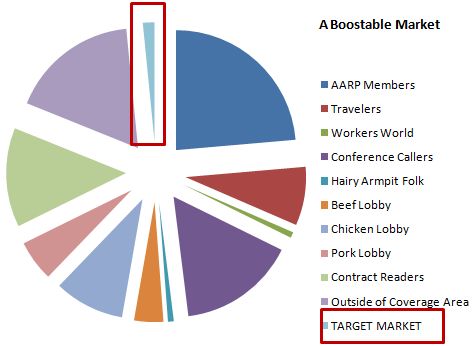
A Boostable Market
So after doing some fuzzy math and over generalizing some category definitions, I’ve been able to carve out the target market for Boost Mobile.
Let Your Fingers Do The Walking
So to round out this piece, I did a little more clicking around their site and found out this just might be clever marketing. Boost appears to be a niche marketing campaign/brand for Sprint. This actually might be a good idea in that context. A new brand which appeals to very small user class which spends into abnormally high per call and unit values to help them achieve profitability.
First, the good news: Sprint narrowed its losses considerably, compared with a year earlier. For the fourth quarter, Sprint lost $1.62 billion, or 57 cents a share. This is certainly better than the $29.45 billion, or a whopping $10.36 a share, it lost during the fourth quarter of 2007. The previous year’s losses were due to some large write-downs the company was forced to take related to its merger with Nextel. This time around, Sprint only had about $1 billion in write-downs.
Now for the bad news: Sprint is still losing customers. And as a result, its quarterly revenue declined about 14 percent to $8.43 billion.
Perhaps this is their answer to all the customers they fired in 2008. If they were smart, they would have direct mailed the fired customers before the firing and after. I could see it now – “Wow, the heck with Sprint I’m going with Boost!”
At the end of the day, it appears that Sprint continues to pursue paths out of it’s historically negative customer experience and market activities, so perhaps boosting a market is a good thing.

here you go, been slacking for a couple of days or more:
The names and questions that we get as a Product Manager are all other place from a title and role perspective. However; answering the “just what is that you do again?” or the confirmations of what I do “Oh, you’re like a project manager, right?” are equally not as fun, which is something most Product Managers have to endure throughout their career.
So we all end up describing what we do in non-traditional job descriptions, which may resonate with folks. Doubt it? Take a look at the tweets from ProductCampBoston.
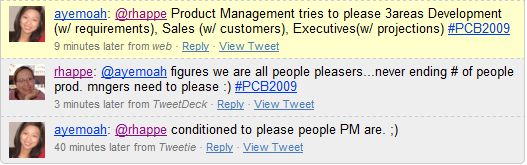
I’ve never considered myself a people pleaser, but corporate politician or favor trader works, which is not inconsistent with the Tweets above. Ultimately the activities, ownership and accountability for PM’s is a difficult thing when a company has all 4 of the PM’s types – Product Managers, Product Marketing, Project Managers and Program Managers. On any given product, project or initiative all 4 can be involved and ownership can be difficult to discern and each may have some level of conflicting goals/motivations, but that is have the fun of being a PM. So I’ve been stuck on the 4 PM concept for like 2 weeks since I talked to a friend:
“We started a project the other day and it has a Project Manager, 2 Product Managers and 1 Product Marketing person and my boss is more worried about how the PMO office is going to report on it, rather than if we are doing the right thing” – Annoyed Program Manager.
Oh the right thing! The right thing varies by job description and role, ownership, influence and visibility across the business. So while I haven’t taken much issue with being introduced as a project manager, program manager or a product manager to clients, it’s mainly because in any given situation a product manager can be 1 or all of the roles. I do know however that if dialed in correctly having all 4 roles can deliver good things for a business and a product. So figuring out what each person does is an important thing and may vary from project to project and release to release.

So I thought it might be a good time to put to paper a delta analysis of what a PM does of each iteration.
Project Manager: The Gantt Will Set You Free
Ever since Henry Gantt pioneered the controls, constructs and made a pretty chart with critical path diamonds, Project Managers (PM) have objectively been presenting slip risk, providing two sentence summaries and yellow/red/green bubbles to management teams everywhere. Have MS Project can travel! The reporting and task management realities of development, launches and organizational readiness require an attention to detail, lack of emotional investment and organizational balance which typically isn’t a core value for a Product Manager (PM).
The successful interaction of all PM’s with the Project Office is an imperative, since it is typically an agnostic group which is solely accountable for schedules, costs and trusted objectivity. The best models are to have this as a standalone group. Not all organizations have this type of functional independence, but they should. I had a friend who once had the PMO in his PM group and let me tell you, that is a completely unfair organizational alignment for development and support, but a makes for a pretty cool Product Management time.

Product Management: Nebulous Interactions and Priority Juggling
While there is no patron saint of Product Management (PM) like Gantt for Project Managers, we do however have Dilbert and I’m OK with that. I’m sure there is some developer somewhere is going to say Dilbert is theirs, but that just part of the life as a Product Manager.
Product Management is different in each organization, with different title lengths and varying levels of P&L influence/accountability. Some are business owners and others manage requirements – some do all, while the common theme exist “You have to keep things going right way and manage priorities”. PM’s are responsible for optimizing the cross functional interfaces, customer value and competitiveness of their product in the marketplace and that creates a bunch of Dilbert moments. PM’s just dance around the organization and try to make things work. In the more technical organizations these folks are constantly managing the delivery of IP to Product.

Program Manager: Strategic Managers of Stuff
Program Managers have the DNA of both the previously evaluated PM’s, not so much Product Marketing folk tho. These are link Project Management Ninja or pattern a matching Product Manager of strategic things. Essentially a corporate tattletale of cross project collisions and the celebratory target for things that randomly align. This is a great gig for project managers and product managers alike – especially if you get organizational resource influence. Actually it could quite possibly be a really good gig with the right company: organization switching, cross product reporting and interfacing with strategic clients/executives. There is significant risk of incremental sport coat requirements in this role.
While there are at least 1000 product managers at Microsoft, who each admittedly have a tough time articulating their role in the Borg, the MSFT program managers readily admit that “Dude – I got a sweet gig!” and have a REALLY hard time explaining what they do. It might help just to understand the difference in a program and a project:
1. A project is unique and is of definite duration. A program is ongoing and implemented within a business to consistently achieve certain results for the business. A project is designed to deliver an output or deliverable and its success will be in terms of delivering the right output at the right time and to the right cost.
2. Program management includes management of projects which, together, improve the performance of the organization. A program’s success will be measured in terms of benefits.
3. Benefits are the measures of improvement of an organization and might include increased income, increased profits, decreased costs, reduced wastage or environmental damage, more satisfied customers. In central or local government organizations, benefits might include providing a better service to the community.
4. In the course of achieving required results, business programs will normally understand related business constraints and determine the processes required to achieve results based on resources allocated. Improvement of processes is a continuous operation that very much contrasts a program from a project.
5. At the lowest level project managers co-ordinate individual projects. They are overseen by the program manager who accounts to the program sponsor (or board).
I kinda see it like being a “cross-thing” corporate gardener and really similar to the other PM’s – the only difference is scope and lack of titles about director.

Product Marketing: Go to Market Magic
Product Managers (PM), not unlike program managers, are responsible for the random alignment of product goals and revenue optimization. The right story, the right capabilities and the marketing mix are essentially the domain of Product Marketing folk. Moderately good excel and PowerPoint skills are essential. These folks are the organizational sanity check on a given product or set of products. Sales enablement, product level brand connection and consumable stories which drives revenue and reduces cost. For most organization’s being a PM is like being a Product Manager minus product delivery.

No matter where your company is in the 4PM model, all you need is a little trust and experience to make it work. Detailed job descriptions help too, especially if you have all four.
Maybe I should have just tried to explain the roles by the core apps they use:
New Here?
In general I blog about technology, music and marketing. Not necessarily in that order. Add me to your reader or subscribe view email.
cheers! ~jon

