Marketing IS in the Middle: Vikram Singha

So with the recent examination of my overall social network I got to thinking about the people who responded and those that I engage over and over to learn from, either via social media or in person.  To that end, I’m starting a series of interviews on Marketing, which are essentially just 7 questions.  I’ve got a bunch in the queue already, but wanted to start with a key influencer to my marketing experience, Vikram Singha.  I had the pleasure to have Vikram in my group for like 4 years and to work along side him as a peer during his last role I worked with him in.

Vikram is the type of product manager that looks at the numbers – the opportunity and the revenue, plus one of the best statisticians I have ever met.  Vikram is one of the founding members of Global Energy Talent and responsible for Marketing.  To that end, below is Vikram’s overview on how Marketing’s in the Middle from his experience:

What marketing roles have you had and in what markets?
Strategic Marketing- Federal Express; Ecommerce and logistics; worldwide
Product Manager- Inovis; B2B software and services; primarily US
Marketing lead- Global Energy Talent; Human capital  services for the energy industry; worldwide

When you look at your career in marketing, what discipline/component have you found most interesting/challenging?
The sales and marketing interface.  At most of organizations where I’ve worked there has always been tension between these two functions. The push and pull happens on many different levels:

  • who to target?
  • What markets?
  • What to build and pitch?
  • How to price?
  • How to get to the decision maker?

The successful organization aligns the Sales leader and the CMO tightly and creates structures that allow these teams to interact both formally AND informally. The trick is to make sure there isn’t an echo chamber and that creative differences can be brought out and thought through. My sense is that short term focused organizations (typically the tech industry which tend to be more quarter-driven) tend to have more differences. Managing this is always a challenge, as well as part of the fun of marketing.

What do you feel the most important component of a successful marketing gig?  (Product, Brand, Positioning)
Positioning. At the end of the day Marketing’s role is to tell the organization’s story– to prospects, customers, employees and different stakeholders in the market at large. This all boils down to how you talk about yourself, how you empower everyone in the org to tell the same story. Once you sell the vision then its easier to make the transactional sale, whether it’s a product or service.

Since you selected Positioning, how has that contributed to revenue in your experience?
Example at my current gig: Am part of a startup providing recruitment, training and consulting for the energy industry worldwide. We’re competing with both large global generalists as well as regional specialists. The only way we can get access to decision makers is to focus very specifically in one vertical domain and immediately connect with a pain point that most in the industry are generally aware of but usually don’t verbalize- lack of technical talent and the process to fill the crew gap. We’ve done this in a variety of ways and channels, and as result have entrée (and ongoing projects) at quite a few global oil majors that wouldn’t have given us the time of the day if our story was uni-dimensional. Being in the services industry (read: low IP) the value has to be defined at a very fundamental level, else it then just becomes a nickel and dime game.

What experiences brought you to this conclusion?
Trial and error!

If you could design the perfect corporate environment for a marketer to be successful what would that be?
Probably an environment where there is freedom to experiment. Ability to learn, and more importantly, institutionalize this learning. Key point is that this is not a marketing issue, rather an organizing principle at its core.

How far is this from reality?
Some companies are doing this already. Toyota, Apple, P&G, Nokia, Ideo. In fact Ideo has some very interesting approaches to ethnographic learning systems that drive marketing design decisions.

Been thinking all summer long on the value of creativity & access

Thanks to an post I read at TUAW, I got to thinking a little bit about “the product” music artists bring to market and how new models of distribution, access to the market and the ability to engage the community has changed things. Wayne Sutton‘s post on 7 Reasons why Twitter is good for the music industry was another post which got me to thinking about this too.  What is the value of a creative product if no one knows about it?  What is the value of a product when it is freely available?  When does a creative product transition from free to fee?  I guess these questions could be post/series in and of themselves, but each requires acknowledge.

With so many unknowns surrounding these question, many organizations and artists are erroring on access to their product as they engage the marketplace, rather than taking a protectionistic approach online.  So why is it that some labels and artists aren’t on iTunes?  I suspect it is just math.

I was expecting on my research to find a different set of folks not in the iTunes catalog then the last time I looks and this is not really the case.   The list of folks is fairly long who aren’t in the iTunes catalogue, but talks continue with various holdouts, so maybe the landscape will change. Ultimately, it’s just a business decision to participate or not.  For some access is more important than transactions, but I’m sure everyone would like to get paid if they could.

<insert transitional concept – oops don’t have one>

Kid Rock is still a holdout for iTunes, I only know this since I had to buy the CD to get it on my iPod, which is also another reason for this post.  The retailer, Kid Rock and his label got 10X with my CD purchase which I suspects generates more revenue than a $.99 download.  It’s appears that music has all the 4P’s of the marketing mix – product, placement, promotion and price.

I understand — ultimately Kid Rock has a product and he doesn’t want to sell his product for $.99 – understood. I’m not sure how the PxQ formula is working for him, but I would think it impacts cash flow which is pretty important in this economic climate.  It took me like 4 months to buy the CD and  I would have bought the single on iTunes months ago.

Curious thought — I wonder if this economic climate makes the holdout list a good deal shorter 18 months from now?  A significant 1 time royalty payment and slices of $.99 downloads just might help generate the needed cash for some folks to make it out the other side of this market.

Less logos, more mileage and more cash

Not sure why, but I’m very intrigued by the auto bailout.  Potentially the state of this industry could be seen as a forecast of what’s coming, more so than what we need to do specifically for Detroit.  Pending systemic failure?

It clearly feels like nothing is immune from the current state of the economy and we may actually hit 10% unemployment before it is done.  In that context, the auto bailout is just the next one, not the last one if we don’t do something.  Every industry is contracting and the Auto bailout needs to happen to avoid a further melt down.  This is where trickle down economics has easily visible/verifiable relationships – in a contraction.  .

I’m not a give free money to everyone kinda person, especially large corporations that refuse to make tough decisions which will take them, the industry and the market forward, but sometimes ya gotta give a little to get a little.  If the auto industry goes others are soon to follow, here’s some other industries which could trickled down….:

  • Transportation – Parts movement and car delivery. The automotive just-in-time fulfillment model support probably 1000’s of small business owners.
  • Electronics and High Tech – There are chips all over these fancy things and many high tech manufacturers don’t only do parts for consumer electronics, but also the auto industry.  Don’t forget every car has a radio with speakers.
  • Financial Services – No really, it can get worse….
  • Local Economic Impact – no factory means no purchasing at the local diner or retailer, I know not an industry, but perhaps it could be considered “small business”
  • Advertising (Print and TV) – I think like 20% of all ad spend is auto, not sure where I remember that from but it is significant whatever it is.

I’m sure there are lots of options – mergers and bankruptcy are definitely options, but there may be some other ones.  So how could the big three get out of this relatively intact?

  • Break up the Unions – there are plenty of successful automotive manufacturers in the US who don’t put their employees at risk, pay them well and in general are good corporate citizens without Unions.
  • Incentives for the Consumer – If the car companies don’t get some cash they are in trouble and a market driven approach may be a good way to reduce inventory and generate cash.
  • Logo reduction – There are just too many brands for these 3 companies to effectively manage profitably.

Break Up the Unions

I’m a Michigan native, so I love unions – sorta.  I’ve seen how unions have delivered disproportional benefits for the labor/effort/value provided which in some circles is something to be loved.   Union scale is good stuff if you can get it, as I have many a friend who went into a factory made gobs of cash since 18 and now have vacation homes, jet skis and generally a good life, possibly leverage life, but with no real skills or alternatives if things go wrong way.  I see this as being mainly due to the unions.  Good job team – an unskilled workforce and debt!

For the corporation the benefits are even more wonderful – bloated cost structures and throttled productivity.  Unions fight for platinum coated health plans, retirement plans and more raises than most folks in the private sector get based on merit and corporate performance.

Simple Math: If the benefits weren’t so steep, they may actually be able to hire more people, rather than giving folks $30,000 a year in overtime.  It’s cheaper to pay overtime than it is to support hiring a new person.  Unions may have served their usefulness.  Today’s transparency in the world today makes it a little had for corporations to put folks at risk and generally not do good.

Consumer Incentives

I’m certainly not buying a new car right now, not because I don’t want to, I just don’t need to.  I might however buy a car if the government gave me a tax credit equal to the profit the dealer and car maker would get.  Give a 1 to 1 credit and generate some transaction in the market and improve cash flow.

So why is this any different than a full on bailout? Well it allows the consumer to invest where THEY want to.  This incentive shouldn’t be limited to the big three, but should be constrained to cars manufactured in the US, so that means that potentially some Big Three vehicles wouldn’t make the list.  After the dust settles there may only be 2 of the big three left, but it would be driven by market/consumer decisions and not due to a knee jerk crisis response.  Folks would buy cars that met quality requirements and other decision criteria.

Logo Reduction

These car manufacturers like their logos and brands. GM has 12 different  active brands, Ford has five brands on their website and Chrysler has three, so why so many?  Does GM really need Buick still?  Can’t HUMMER role into GMC or vice-versa?  As for Ford, not sure you still need Lincoln, you keep the town car and roll it under Ford.  Does Ford also need Mercury?  Isn’t the Mercury model just the same as the ford with better trim and lower gas mileage?  Chrysler is probably the best positioned with just three main brands, but I would think they still want to focus on reducing models, since the town and Country and the Caravan a like the same thing.  Couldn’t Jeep become a brand extension of Dodge?

So what would logo reduction get the industry?  Consumer incentives will help identify what logos to move out of the mix and help with a market driven SKU reduction. There are a bunch of SKU’s to choose from and most could easily be displaced by the other logo alternative.  Less SKU’s means less complexity and the ability to scale production more efficiently/profitably and allow them focus thier innovation efforts.  It would allow them to reduce their marketing costs from labor perspective and ultimately build STRONGER brands.  If these companies could consolidate their design and centers for innovation that would have to have some positive bottom line impact.

Give Them the Money!

What is the danger in giving them the money?  Not much, the downside is much bigger.  The issue is cash and the ability to make it through the recession.  These companies are doing them most they can and bankruptcy just would help.  I would actually up the ante to $25B per car maker – that’s effectively what we gave the banks, but it should have some strings to ensure it stimulates other sectors:

  • Production of cars of <20 miles per gallon needs to stop
  • Overtime budgets need to be cut in half
  • By 2012 all passenger cars manufactured needs to get >25 gallons
  • Trucks and industrial vehicles need to improve gas conumption by 25% by 2012
  • Plants with the lowest 3rd of efficiency need to be re-tooled
  • The top 15 plants with the highest “pollution rating” need to be re-tooled
  • Emissions for all vehicles need to be reduced by 15% by 2012.

This is Just a Cycle

I’m not an economist, but I do like me some history and this looks familiar.  The economy is at a tipping point, not unlike the one that fostered the great depression.  The distribution of skills, the demand for skill types and available capital make for a sustainability issue.

The great depression could be considered a function of the transition from a fully agrarian economy (majority of skills and spending habits) to an industrial economic model (the majority of demand).  So just like the move from a primary sector to secondary, we are transitioning from a secondary economic system to a tertiary sector.  Some might even argue Quaternary or Quinary, but these are more tertiary overlays which are “thought/theory” gap coverage to help understand different modes of market engagement which exists today.

There are all kinds of theory gaps which make for interesting dynamics which need coverage.  The current economic norms for participation are changing – work from home, small business vs. large business, expertise over scale and information over goods are in growth mode.  The challenge is we don’t have the necessary infrastructure, pervasive skills availability and incentives for business to move forward quickly. Government needs to invest in building mass transit, bandwidth and wireless upgrades and provide manufacturing/other industries incentives to modernize – buy more software, improve your plants, adopt alternative energy options and help the transitioning the population with educational subsidies.

I’m not sure we can buy our way out of this, but we just might want to give a big ole American try.

I got bored halfway through this post and started working on something else, but decided to push publish anyhow.  The blogger equivelant of SKU proliferation.

Value Networks: Placing a personal or corporate brand

So I did a little work on understanding who is in my network on Twitter and what I found is that some members are more aligned to what I want to do and others are not. Essentially some relationships are more valuable for me than others. I currently use auto-follow capabilities and it continues to change the shape and scope of my network, not always in the positive but it makes for easier management. At this point, where I used to have to manually follow folks I now have to manually stop following. Not sure which is better, but with just a little more data and a little more context it might be easier to automate or to even manage manually. I’d fully manage Twitter manually if I have information to deliver higher value relationships on average.

Hit or Miss

Today with the available information on a profile there isn’t a whole lot of information to decision from. Right now from a manual perspective, I can look at how many followers and how many they follow, which to me is now an interesting metric I’m going to use as part of my manual unfollow process, but the only influence indicator is follower count. There is currently no set of information to know how folks appreciate being in a given network or their social capital. Ultimately trust and value become additional network dimensions which happen over time, but there could be information display to improve decision making.

So what could be exposed which might encourage following certain folks over others? I know there is grader, but grader is raw numbers and it effectively favors the “old” folks on the platform and personalities, who may not be adding the value today, which they used to add to a nascent platform. “Old” being those that showed up early on the platform, since network size appears to have some relationship to date registered on Twitter, no data, just an observation. According to Grader’s site here are some of the attributes:

  • The number of followers you have – (I suspect it is the biggest weight)
  • The power of this network of followers – (MAGIC?)
  • The pace of your updates – (second biggest attribute?)
  • The completeness of your profile
  • …a few others

Developing a Network Brand

What you do, how you react and how others engage ultimately is what develops a network. So what would give someone a view into these attributes which may indicate “trust” and “value” without having to follow them back and wait and see? How the network reacts to a given user is what might help. More visibility to how a given user is engaged or the perceived value of those which were/are in a user/brands network. I guess you can do this through the use of a couple of tools – Grader, search.twitter.com and a couple of others, but that takes a bunch of time.

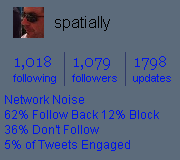
Essentially each of us are building a brand community and your actions plus your network’s reactions are what helps develop a brand. So it might be good to have a feature from Twitter which will help, not so sure it is an existing API capability today or a reasonable extension for the future. Such an influence/noise metrics could be as follows:

It even stays with the “slim” UI capabilities which appears to a Twitter core value. Since Twitter, social networks and social media in general are quickly becoming a key channel to drive access, visibility and participation for corporate brands and personal brands. With this reality being at the right place and developing trust is imperative. This type of feature would help with social media placement, promotion and brand development. Of course a standard would be cool, but I know that’s not possible, so I’ll move on. This will ultimately provide a better way to find/participate in high value networks, discussions and channels for brands. So what would be the benefits for folks with this type feature on Twitter or any other platform?

  • Participate in high quality networks for areas of interest
  • Develop important relationships with folks like you
  • Provide you access to folks that can help with ideas and content and build your brand.
  • Help prioritize where you place your brand online since there isn’t infinite resource or capacity in this economy.

I know there is the obvious question to ask – wouldn’t groups help manage most of these? Not really, only helps indicate affinity, not necessarily value. So in the end, this type of a capability would provide additional metrics which enables folks to understand where to participate from a network perspective. Social media needs more metricsmetrics for business, users and brands.

The metrics could also be used for a given user to improve how he or she interacts with folks to ensure they are delivering value to their followers, I guess this knife cuts both ways. I guess these types of metrics would also be valuable for the development ecosystem too – another life that cuts both ways.

Oh if we could automate trust. I guess we can’t. Oh if we had a way to better understand social capital and how to effectively place a social brand. Now that’s a possibility.