My goodness, the requests for LinkedIn recommendations are coming in a fairly good clip and I suspect they will just keep coming in the next quarter. From my perspective, those impacted by the economy are good solid folk with skills and long term employment histories and for many this is their first layoff and it can’t be fun. This also can’t be a good sign for the economy and it is interesting how LinkedIn has become a bellwether for the economy. Clearly times are tough and marketing yourself and differentiating has to be a challenge in this job market. I was watching CBS early and they had a “job search expert” on, Susan Morem, who authored a couple of books on the topic and she had at least 1 good idea. So here is the Top 5 Tips she offered in total:
“The average job search is 3 months, but could go up to 6 or 9 months”
- Create a Plan – “Know what you are going for – but also know what you will settle for, not a time to be picky”
- Treat Finding a Job like a Job – “Always be on”
- Practice Interviewing
- Market Yourself – “Think about yourself as a product”
- Get a makeover – “You want to look your best… taking time with your appears can make all the difference”
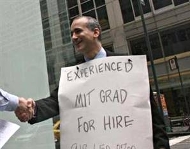
I definitely think the product concept is the right way to look at it, however I can see the allure of a makeover. Just like a product, a job search is marketing with the same marketing mix which needs to be balanced. Think about it – you have a target market and a product. How you position, price and promote your capabilities are critical to landing a new gig. Take a recent piece I saw in one of those lifestyle news pieces on TV that reinforced the promotion reality of marketing your capabilities – an experienced MIT graduate was resorting to standing outside with a sandwich board till he get a job.
There a lot of good folks with talent, experience and education competing for jobs so ya gotta do something. Resumes, experience and skills are abundant and alone won’t do the job in a competitive marketplace. The marketplace is getting more competitive everyday!
I was talking to Sheryl who does a little writing here, she’s does mainly contract marketing work, but on the side she does some resume writing for friends and she has been a little busy lately on that front. At this point in time, Sheryl’s resume queue overfloweth. If Sheryl’s queue is any indicator, I suspect that demand is up across the board. While Sheryl’s focus is writing resumes for executives, she claims that it is becoming increasingly evident that resumes no longer carry the weight they once did. That’s assuming they ever did and most jobs aren’t placed due to relationships, but when most of your network is on the street and part of your competition that kinda sucks which is the reality for several folks I know. Ultimately you have to standout somehow and the standard resume just isn’t going to do it, neither will a makeover.
Take the sandwich board guy, Josh Persky, who I couldn’t find in LinkedIn, he just resorted to a different tactic. Josh created a promotional campaign to standout from the masses. Josh’s plan was to literally stand outside and pass out resumes. What a new and innovative approach, albeit low high tech. Josh just needed to differentiate himself, gain a little visibility and get a foot in the door. To do this, Josh effectively took a social approach to engaging folks which went viral. While this may reek a little bit of desperate it was a differentiator for him as a job seeker and got him some national/viral press along the way.
If you go back to the product concept, a proven MIT executive type resorting to standing on the street handing out resumes must be cheaper today than he was last week and probably 15-25% cheaper than his previous salary, so price might have played a role in his placement. With the right degree (features), a dense population (placement) and some film (promotion) you can make this work, but not everyone will get on national news with their job search. Even without TV, this requires certain geographic attributes – population and traffic. So if you are an EMU grad in Montana you probably shouldn’t try this tactic, but you might try it in Miami. Accepting that this might not work everywhere you may need another plan. Good news for those of you in far flung places without top tier educational pedigrees – YOU have social media!
Engage In A Social Search: Add Inbound Marketing to the Promotional Mix
Where is your resume? Monster? Career Builder? That’s a lot of overhead for the job seeker and I’m not sure it works. 10,000 of thousands of resumes, hundreds of applications and a bunch of quirky to odd intro letters. Social media might even makes a guy in food service look interesting.
Or show the passion and desire of a college student in Ireland:
Both of these presentations show passion and creativity, in absence of experience in a given field. Something that never can be seen on a flat word document or pdf. The power of social media, is it not only enables the jobseeker with options to differentiate, it also offer employers the opportunity to research, validate and see just what you are about. Dishonesty is easily figured out and your experience/execution can validated on LinkedIn with recommendations or the lack of recommendations.
A Social Search
The recent financial crisis has thrown literally millions of people out of work. In the tech space alone, TechCrunch reports over 300+ layoff events and 115,000+ folks laid off. Now that’s a bunch of skills in the marketplace. Standing out in this kind of supply glut requires some thought. So how can you differentiate yourself from all of the other job seekers out there? One way is to embrace your social media activities and use it as a differentiator. A recent Wall Street Journal piece validates that using your social network and social technologies, are at least good so social media jobs, at least for 1 person Alex Scordato, who got a job a Mzinga.
What you write, what you link to and where you are online and your actions are easily visible so try and create coordinated effort to leverage these to your advantage. Things to ponder:
- If you take your writings, rants and tweets and look at it in context of your resume and career goals what would that say?
- What conflicts to your resume would it surface?
- What would it reinforce?
So your blog, your Twitter profile, visual resume and your LinkedIn profile and what ever else you have out there just might provide a way to differentiate or minimally provide more options for discovery (placement). Basically you need to create a integrated strategy for managing your personal brand/product in the job search which allows for multiple inbound channels and discovery options.



