
All Posts By

Jon Gatrell

Roadside Observations: Population moves and a sign of the times

So I was doing a little bit of travel over the holidays and got to see a good bit of the back roads country and survey roadside advertising. The quality, product mix and “vacancy rates” appeared to have changed from what I historically remember. Although I will say that promotional messaging for empty billboards is getting much better. The other interesting thing is the use of “shared space” appears to be up for billboards….

Billboards may be a bellwether for the state of the economy and represent a great part of the cultural landscape which I like to appreciate. I originally wrote myself a note on this topic last week, but was reminded of the concept by Vaguery on twitter, who in real life is Bill and blogs over @ Notional Slurry. Economic trends and perceptions of the economy impact individual, local and regional buying behaviors and how marketers appeal to buyers.

Vaguery’s tweet of “…considering the likelihood of any Michigander doing real five-figure cookery” seemed to align with billboards, data and articles I’ve been reading/seeing, such as the USA Today piece I read over my free continental breakfast the other day. So things are changing – spend patterns, the movement of people and general open market activities.

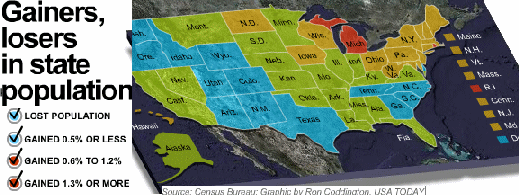
The USA article spoke of the current housing woes and how they impact population movement. “Michigan hard hit by cutbacks in the auto industry and other manufacturing sectors” has seen population decline and housing value declines ahead of the rest of the nation. This was unscientifically verified as I drove around and saw more for sale signs than I think I have ever seen.

At the most basic level, demographic changes impact market dynamics – specifically how people market and what they market.  With a more granular look at the population shift, by state, it becomes evident that Michigan and RI are seeing a different level of change than other markets.


With the change in the economy and population, the roadside marketing landscape has changed as well since general investment patterns change from all key constituents segments – government, national brands and local SMBs. This change appears to be visible in the current billboard mix being mainly casino oriented in Detroit – no longer automotive/manufacturing innovation related.   The overall billboard content also appears to be on a different level of creative quality as well, not just the type of advertiser. I was able to find the following billboard just outside Lansing in Portland, Michigan which is an example of the changing billboard landscape throughout Michigan.



I’m glad I’m not in billboard advertising with a weakening dollar, tempered consumer confidence and the apparent need for cheap pepper spray as a stocking stuffer.

Top 5 Posts: By Genres

The following is a Top 5 list of several genres.  These are posts I wrote and I liked, Emily wrote and I wrote and no one seemed to like.

[tag]Top 5 Posts[/tag] I wrote for 2007 in my opinion

  • The Collaborator – Part of the stuck in the middle series, but I think this could standalone outside of the [tag]humor[/tag]ous series on [tag]middle management[/tag] impact.  I only have like 4, possibly 5 left which I will go back to in January.
  • [tag]Market Sizing[/tag] – A piece I did on a friends blog @ Launch Clinic, David is a very cool cat and a great product marketer.
  • Meeting Maxims – A random gram on [tag]running an effective meeting[/tag].
  • Thesis Fodder – A general observation on [tag]blogging styles[/tag], not sure it’s right, but it helped me understand better this blog thing.
  • The Geologist – This stuck in the middle piece as a homage to a friend

Top 5 Emily Wrote, while she’s not necessarily a blogger, she carves out time now and then to do things of interests.

Top 5 I liked, but no one appeared to like

  •  Geographic 25 – A set of topics to encourage posting by others.  I met Edward V. because of this, so it was great because of that alone.
  • Mosaic – I thought it was fun, but a friend of my referred to it as being just a little conceptual and obscure, but I know one person got it.
  • The 5th P – A proctor friend referred to this as blasphemy, but I think portfolio management is the 5th p.
  • B-Travel and General Travel Posts – I like these, but I think they are all about me and that’s ok.

This is more than likely it for 2007, see you in 2008.

Holiday Greetings to All

While not all inclusive, my way of wishing everyone well.

  • Happy Holidays
  • Buone Feste
  • Felices Fiestas
  • Season’s Greetings
  • Merry Christmas
  • Happy Christmas – they do this in Australia apparently
  • Merry Xmas – rooted in the Greek word Χριστος.
  • Merry Yuletide
  • Good [tag]Yuletide[/tag]
  • Happy Yuletide
  • Merry Midwinter
  • God jul
  • Hyvää joulua
  • [tag]Glædelig jul[/tag]
  • Joyous Yule – [tag]Wiccan[/tag] or [tag]Neopagan[/tag] greeting for the [tag]Winter solstice[/tag]
  • Joyeux Noël
  • Buon Natale
  • [tag]Frohe Weihnachten[/tag]/Fröhliche Weihnachten
  • Mele Kalikimaka
  • Nollaig Shona Duit
  • S’Rozhdestvom Kristovym! (С Рождеством Христовым!)
  • S Rozhdestvom!
  • Feliz Navidad
  • [tag]Feliz Naviblah[/tag] – a [tag]my name is earl[/tag] bit
  • Happy Kwanzaa
  • [tag]Wesołych Świąt[/tag]
  • Habari Gani
  • Happy Chanukah
  • Chag Sameach
  • [tag]Gut Yontiff[/tag]
  • Happy New Year
  • [tag]Milad Majeed[/tag]
  • Kul ‘am wa enta bi-khair
  • Taqabbala Allahu minna wa minkum
  • ‘Īd mubārak
  • ‘Īd sa‘īd
  • [tag]Bayramınız Mübarek Olsun[/tag]
  • Selamat Hari Raya
  • [tag]Salam Aidilfitri[/tag]
  • maaf lahir dan batin
  • Christos Voskresse! (Христос возкресе)
  • Saehae Bok Mani baduseyo

Be safe!

What the world needs now

Is another pop singer, like I need need to read another obtuse article on Web 2.0.  Nevertheless, I do think we need a new way to look at web 2.0/enterprise 2.0 and Jeff’s piece prompted me to finally write something on this. The challenge is the current labels are just BIG and somewhat empty – is the technology? The application? The deployment model? What’s WOA?

Not that these new modes of development and use of mashups don’t produce value, because they are and will grow in value, but the label is just a little too cutesy for traditional business folk to be readily supportive, IMHO. A software analyst, at a leading analyst firm, recently noted that when [tag]Enterprise 2.0[/tag] was coined it’s genesis was sorta tongue and cheek, not sure how he knows, but he said so and I believe it and thats it. Relationships can taint any reality, which might be why Web 2.0/Enterprise 2.0 is such a big and hot topic, since it is as much about the workplace as it is about people which has this egalitarian feel to it and phreaks business people out, so does spelling words with PH.

If you don’t think folks are backlashing against the cool nomenclature, then you might not be paying attention and Andy’s blog would not have the “if a tree falls in the woods” feel, which at times seems more tempered than evangelistic. Admittedly I read it and I clearly am hearing the tree fall along with 1000’s of others, but the core concern for me is how to take this stuff seriously and deliver an actionable plan/platform for businesses. The answer? It could be as simple as a new name, yup, marketing 101. It might not be THE answer, but could be AN approach to refine the space, since I’m not sure the 2.0 will be “jettisoned” and I think we will get a 3.0 soon enough from some smart person. Right now, we might as well talk to the concept as “Super cool stuff you can do online for your business and you users”.

So what would this new thing be labeled? The common theme is share infrastructure, combined function and pervasive content consumption and creation by users. So this is my stab at it the New, Improved, Faster y mejor suave look at these applications:

Enterprise Internet Asset Platforms: Manages the interaction of corporate assets in a distributed framework from multiple vendors. These applications and frameworks manage the content, users and functionality in a secure environment on demand based on individual configuration driven by role based productivity needs within an enterprise’s given governance model.

These platforms represent frameworks and deployment models which allow for use of best-in class feature delivery at the user level, ultimately delivering user specific productivity enhancements not available in monolithic business applications, but also include features and capabilities from traditional enterprise applications.

I’m not married to this market definition, but directionally I think this is what is needed. We need a less nebulous way to speak to this than Enterprise 2.0. Enterprise 2.0 is too big and requires you to sell down the value, when starting with a set of known things and selling up into the vision is a whole lot easier. Just my random idea on how to ignite [tag]E2.0[/tag] and reduce the confusion.

So let’s think about how we can better package the concept around real business problems and address the concerns of opening up the enterprise to social computing, which is both inside and outside of the enterprise. The concepts of user based application selection for many reasons may challenge traditional thinking, but if users could carry their knowledge, applications and networks to a new business this has to bring value to organizations.

The first real application to think about enabling Facebook for businesses which has received attention of late is Workbook. Workbook however needs a little help with their product description, but if their marketing guy or gal can move away from the verbiage below and couch it in an ROI it could go hockey stick:

WorkBook: Secure Facebook for the Enterprise

WorkBook – a secure enterprise overlay for Facebook. [tag]WorkBook[/tag] allows employees to securely interact with their peers using the hugely-popular Facebook service. WorkBook combines all the capabilities of Facebook with all the controls of a corporate environment, including integration with existing enterprise security services and information sources. With WorkBook, employees can find and stay in touch with corporate colleagues, publish company-related news, create bookmarks to enterprise application data and securely share the bookmarks with authorized colleagues, update on status change and get general company news. Employees can freely use Facebook, with the WorkBook overlay, with no danger of information leaking outside the organization or access being granted to unauthorized personnel.


Just a little too techno-centric for more my decision making, but someone has to start the discussion and Facebook [tag]governance[/tag] is as good a place as anywhere to start.

Where and when are you going to start?