Oh development – they HAVE to be the problem, that’s the common believe in a good deal of companies. The next expert in delivering his take on Marketing being in the middle is one the of best technologist I’ve worked with and a development leader writ large, Ben Cody. I call him Benji, mainly in my head, but he is a what I refer to as a practical visionary. Ben transitioned from be being a developer leader with great ideas I depended on for years to an industry leader in B2B technologies and BPM. I trust Ben on every level because he provides input, improvement and access to his ideas and team, not a common thing for a marketer (my opinion) and why I think it is important to get his marketing insights. Ben currently is VP of Product Management at Global360 and continues to change the industry, glad to know him – glad he participated in the interview below.
What marketing roles have you had and in what markets?
Various roles in Product Management, Product Marketing and Field Marketing in the enterprise software markets, with a predominant focus on Financial Services and Manufacturing.
When you look at your career in marketing, what discipline/component have you found most interesting/challenging?
Although not what I do day to day anymore, the field marketing. Demand generation is a challenge – getting people to respond to various programs – was one of the more fascinating studies in human behavior. A given tactic works for one product, but not the other.
What do you feel the most important component of a successful marketing gig? (Product, Brand, Positioning)
I came out of development, so I’m definitely a Product person. The product is the hardest one to change and takes the longest to build right. The right product with the right capabilities which solves problems is all that the market can ask for. But this often isn’t the product that marketers are positioning. Buyers see through lipstick on the pig these days like never before, so stretching capabilities in a data sheet or simply polishing the UI doesn’t work in a competitive marketplace. Too many were burnt in the last big wave of enterprise IT spend back around the turn of the century, so Product is the key component.
What experiences brought you to this conclusion?
I’ve worked multiple markets, in various stages of maturity, from new markets to laggards and with varied targets, such as the SMB or Enterprise. To that end, I’ve spent a good deal of time taking legacy products and repositioning them has taught me the hard way that lipstick wears off. Not that much fun, profitable, but not fun.
If you could design the perfect corporate environment for a marketer to be successful what would that be?
I’ve worked multiple markets, in various stages of maturity, from new markets to laggards and with varied targets, such as the SMB or Enterprise. Along the way, I’ve been fortunate enough to work with some industry leading, incredibly innovative solutions, as well as my share of also ran’s and legacy products. No matter how hard you try, lipstick wears off and the pig over time, and the pig will show his real face. In many ways it’s like cooking, if you don’t start with quality ingredients, you won’t be satisfied with your meal in the end. If you could design the perfect corporate environment for a marketer to be successful what would that be?
It’s the leadership and how they view investment, market pursuit and strategic planning. Leadership starts at the top, so in my experience the #1 thing by far is that the CEO needs to have a vision for the market and the company that they pursue above all else. And that vision needs to be something more than a targeted earnings per share. Typically these leaders come from sales. They do occasionally grow up through the product ranks as well. What I’ve seen fail is a pure P&L oriented mentality that is typical of leaders that grew up in the finance office. In fairness I’ve known a one or two finance types that were good CEO’s. But finance types are the ones who ran GM, Ford and Chrysler for the last 20 years. These are the leaders who didn’t feel there was enough $ in hybrid cars (forget the environment) or that “good enough” quality was good enough. – need I say more?
How far is this from reality?
It is the reality today in successful companies…



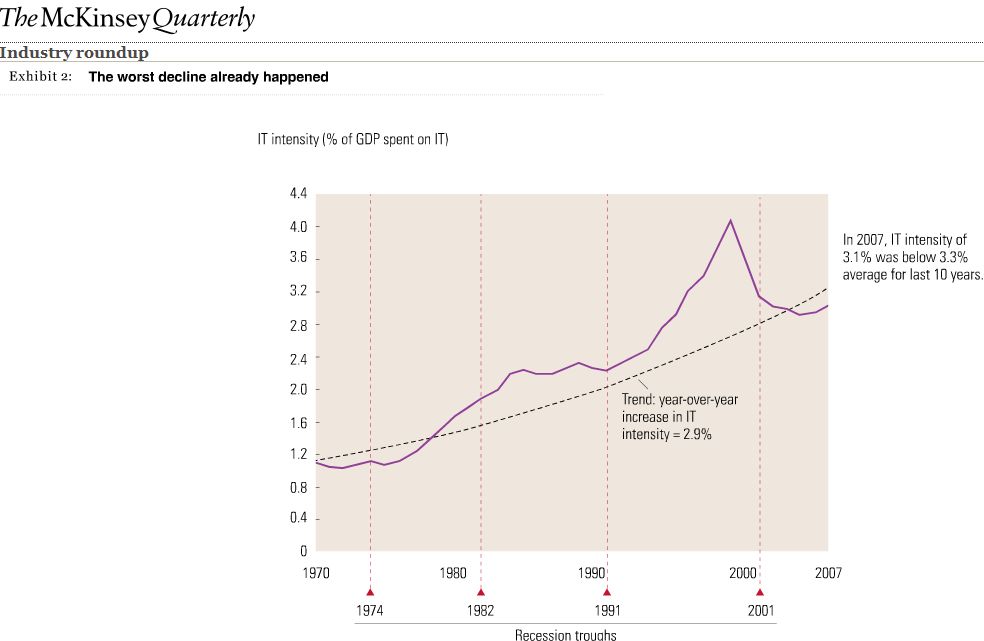 SOURCE: http://www.mckinseyquarterly.com/Energy_Resources_Materials/Steel/Industry_trends_in_the_downturn_A_snapshot_2264