What is social media? A better question is what isn’t. It’s not big, it’s not broad and it’s not for sale for the most part. That’s a HUGE problem for traditional marketers. To keep it simple – you know social media when you see it. The Social Media Club provides this definition/framework:
Social (from Merriam Webster)
“1 : involving allies or confederates
2 a : marked by or passed in pleasant companionship with one’s friends or associates social life b: SOCIABLE c: of, relating to, or designed for sociability
3 : of or relating to human society , the interaction of the individual and the group, or the welfare of human beings as members of society < social institutions>“
Media (from Merriam Webster)
” 1 : a medium of cultivation, conveyance, or expression;”
Wikipedia defines Social Media as “the online tools and platforms that people use to share opinions, insights, experiences, and perspectives with each other. Social media can take many different forms, including text, images, audio, and video. Popular social mediums include blogs, message boards, podcasts, wikis, and vlogs.”
By this definition social media is essentially a set of infomediary channels. These conversational channels are equally available to individuals and corporations which makes “controlling the message” or positioning the brand a little more dynamic. The dynamic and egalitarian realities are requiring organizations to add corporate bloggers, community managers and SEO folks to the payrolls to shape the discussion. This latest corporate internet frenzy does have a little bit of the “we got to be there” feel of the early internet which spawned the explosion of webmaster roles in IT which transitioned to more creative roles in marketing many organizations. Technology has a way of developing new disciplines and requiring new skills and investment in people – social media is no different. Social media may actually be organizational development writ large – a new model for organizations, Social Management.
With the new roles on the org chart comes a new worker, a connected conversationalist, where work and life are a balanced set of commingled actions which are agnostic to both place and time. I’m not saying everyone is going beduin, but personal is becoming professional and where and when work happens is different. Markets are becoming social, professionals are becoming personal and brands, at social media’s most atomic level, are their tags.
Social media is changing relationships within a business and how everyone at a company contributes to the success in the marketplace and how customers are re-defining old brands and showcasing new brands. The change will be bigger than it appears on the surface.

Yes – looks are deceiving and that’s a fairly sweeping statement, but the new roles in organizations and the proliferation of platforms such as Facebook and Twitter ARE the leading indicators of change, it also loosely ties into my recent theme on corporate gardening, which I see as a good thing. (The other challenge is there is not a whole bunch of empirical data, so you take what you have and create a plausible relationship and hiring practices for social media roles is a fairly compelling data set.) Social media is on the edge of mainstream for corporations the graphic from Indeed below shows the historical growth of social media roles in the marketplace:
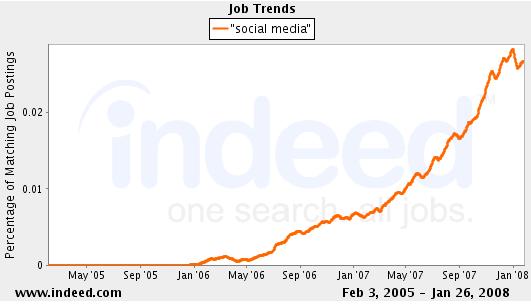
The initial focus of change in many companies is within the marketing group, but support and development jobs are also carrying the social media tag. For now, social media is changing marketing more so than any functional group. When will it be a requirement to show your social portfolio as part of the interview process? How long until there are generally accepted new media launch toolkits and methodologies in the marketplace which start showing up on monster profiles and ads?
Understanding/Overstating/Underestimating the Impact
Social media is not so much about direct influence of revenue, but more of a market optimizer – which DOES impact revenue. Current revenue streams AND future opportunities. Essentially social media aids in making markets more efficient with pervasive communication, connectivity and real-time transaction capabilities. It’s a fundamental change in market mechanics.

Think about it – People buy from people right? Social media is about people. Not huge logic jump that times they are a changin. The change in the mechanics can be seen in the rise of social media platforms as preferred places for interaction and research for many consumers/individuals/employees. The emergence of the social customer isn’t just the re-tooling of word of mouth marketing, it is a change in influential scale – a single customer’s opinion can now influence 1000’s of prospects, not just a handful at the barbershop.
Social media is essentially just starting to prime the market pump – removing the air from traditional “brand out” messaging and requiring more substance for “brand flow”. It will clearly take some more time to have all the “plumbing” in place and air out of the line, but we can see that folks removing the air from the buying process, such as Cushman’s Toyota Yaris experiment. Don’t like the pump metaphor – another way to look at it is as a market lubricant which reduces transactional friction caused by the legacy market mechanics.
A Frictionless Market
Markets traditionally are made less efficient due to brokers, intermediaries, traditional marketing, limited access, price variability and the inherent transactional costs of the exchanging goods of value. The fundamental mechanics of communication, value creation and brand management has been diffused into a community of infomediaries – customers, former customers, competitor customers, employees and former employees. For good or ill access to people, information and influence impacts loyalty, awareness and product placement. There is a downside – the risk of commoditization exists with the reduction of transactional friction in the market. Easier to compare, easier to shop – essentially accelerated discovery and understanding.
The Back End Brand
Discovery and access is changing the messaging imperative from who can shout the loudest to the biggest poplution to be considerably narrower engagement – a conversation. Reviews, diggs and micro-content will essentially piece together a brand mosaic which is the brand identity. Today marketers spend time, energy and money on developing mass awareness and cultivating a sense of value before the commercial transaction. Social media is allowing the customer to do this now in parallel.
Essentially the front end brand investment seen today, will need to shift product focus on service and the ability to influence the conversation in a segment. Brand management has moved from perpetuating a mass market myth to influencing post transactional conversations and community lore. Ultimately social media transitions the definition of brand and value to the service chain.
If this is the case – should customer care/support be part of marketing? Or should support be a standalone product with a product manager? Is this the new portfolio manager? This is going to be an exciting time and good market change. So as a marketer, manager or contributors what can you learn and unlearn to leverage this change in the mechanics of the market? I don’t know what the future holds, but I thank Jeremiah and for getting me thinking about it based on the Tweet below:
@oracletechnet says community managers (before social media) used to be called ‘editors’. I’d say they were called Support or Account team
Not sure I made a point, but sometimes you just have to press publish and move on…..


