
Sharing the links for the day:

This is a guest-post from Stephen Smith – small business conversation consultant, public speaker, and the editor of Productivity in Context where he teaches people how to use basic tools and simple practices for taking control of their workflow situation, practical ways of being more productive at work and at home.
These practices are designed to give you more time to do the things that matter to you!
Recently a friend of mine and newcomer to blogging had an inspiration for a thought-provoking post. He carefully crafted his message into three bullet points with clever details and thoughtful insights. Since he had been quite prolific recently, he post-dated the article to run three days out.
Then disaster struck…
A duplicate post!
A similar post was featured on an established blog with a large readership.
What to do?
Since two heads are better than one (even if one is a cabbage), he sent out a call for help on Twitter (where you get breaking news first!). Never fear, I told him, this is what you do:
- Run the post right away, with two quick changes:
- Add a link to the other post at the end of your article. It never hurts to acknowledge the other writers, and it definitely helps to get you noticed. Also, by pointing to the similar post, you can emphasize the differences and not look like you are hiding behind a copy-cat post.
- Re-arrange your article to highlight the differences. My friend had written his post from a slightly different perspective than the bigger blogger. This meant that by simply moving some paragraphs around he could leave his readers with a much different mindset at the conclusion of the article. Then, by linking to the similar post, the interested reader could go and see the same topic from a completely different point-of-view.
- Send an e-mail to the author of the first post and introduce yourself. Let them know that you wrote a similar piece on that topic the same day, but with a different slant. Don’t ask for a link, but provide a link to your post in the e-mail. Perhaps you get a link, perhaps you don’t. In any case you have planted the seeds of a relationship.
- Subscribe to that blogger, so you can keep an eye on their interests and post-topics. This will help you avoid duplicate postings in the future, again, to avoid looking like a copy-cat.
The results?
The post was a success, and the final version, if I say so myself, was much better than the bigger blog’s version. Perhaps it had to do with the re-arranging, or perhaps just because a little more thought went into it. Now, I expect some of you might be saying to yourself, “Yikes, this happens to me all the time!“. Well, now you have a tool set for dealing with the situation.
On the other hand, some of you may be saying, “This never happens to me, my niche is too narrow/broad/non-controversial/etc. How can this help me?” I will tell you how.
When you write a new post, one that you really like, ask yourself this question:
“How would [insert name of favorite blogger] write this post?”
Think on that, then follow step 1.2, above. Re-arrange your post so that it approaches the topic from a different angle, and ends with a strong, non-[favorite blogger]-like conclusion. This is a powerful method for new bloggers to find their voice.
For those same new bloggers, I would also recommend following step 2, above, also. By contacting [your favorite blogger] you can nurture the relationship and foster communication. Let them know that you thought about how they would approach that particular topic as you were writing the post in order to gain a clearer understanding, and transmit it to your readers.
Again, don’t ask for anything but a comment. Just provide the post or an excerpt, and a link to it so they can leave a comment, and be sure to reply when they do comment.
Any questions? Please feel free to e-mail me via stephen at hdbizblog dot com.
With the recent press release from the Social Media Club, everyone is off and running! A new board and new opportunity. So I’ve clearly gotten myself over my head again, looking for some input…. It’s not like being over my head it’s unfamiliar space for me. After my post on the Social Media Club’s execution, I’ve had a flurry of activity around here. After the dust has settled, I have now committed to figuring some stuff out and doing a little effort. Oh what crazy stuff comes from truthiness. Great opportunity, is my take and an interesting process to boot.
After several interactions and a thoughtful discussion with Chris, I’m back to doing standards work, but in the context of Social Media. Chris and I rambled for a couple of minutes on the phone, talked around some my volunteer work in standards and industry groups (X12, VICS, NEECOM, OAGi, RosettaNet and then UCC, now GS1) and shared interest which apparently gave me some street cred. So with this somewhat trivial and completely unverified experience, I’m now able to “officially” allocate some time to the group. The trust economy is indeed a strange thing.
Kinda of refreshing – add value where you can. I guess membership wasn’t a bad idea and yes the t-shirt is great!
The evidently egalitarian approach to this club is fairly refreshing. An interim group to drive the next iteration of Social Media Club was kicked off this week. The group is 42 folks with seemingly diverse skill sets, seems a little big I know. The benefit of this approach is a highly redundant skills architecture to help scale the organization, a service oriented architecture for the organizations. The loosely couple governance model is constrained to a single rule set/theme – “do good for SMC”. In near real-time the group had a list server, press release draft, a wiki and a request for research.
Do The Work
Volunteer organizations are interesting entities – passion, skills and no shortage of things to do to be successful. Same thing at SMC. Every organization I’ve ever engaged in since I was young democrat had more work to go around than folks. So in an effort to start doing the work, I thought I would kick off my participation to better understand Identity.
Social media is a changing landscape where personality, historical actions and group membership/brand association continue to impact the individual and identity. Below is a piece that Chris did a while back to help thinking about how social media and identity are innately evolving or devolving in lock step.
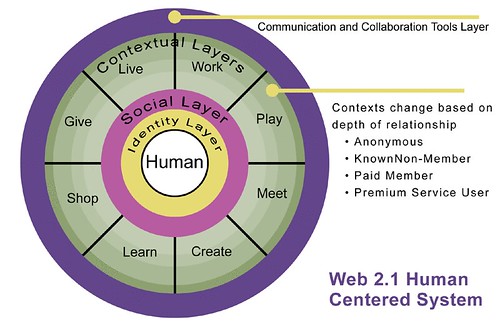
Fractured identity and the limited ability to aggregate access is becoming increasingly laborious set of activities for me at least. Platform fatigue, technology emergence or context changes impact where and how an individual participates, so data portability could be considered important.. That being said, it may not be the priority to focus on which would better enable adoption.
So in the interest of loosely defined research, I am lookin for a little help from my friends. What should be highest priority area of interest in standards alignment/adoption for Social Media Club? Is there another theme or standard which would return significant value to the over all community?
Here is the shortlist:
So let’s prioritize and do the work.
Comment, post or tweet.
If you post your ideas, let me know with a comment or use SMCBOARD as a tag for your post.
Why are marketers so often not interested in doing something new or rethink some of their base assumptions. Too often technology marketers are too “inside the four walls”, a little too technical or distracted to go back and re-examine core assumptions. Should try and do it as much as possible.
One of the biggest challenges/rat holes many marketers get into is being unwilling to make something up or to look at your product/market in a different way. The challenge is how can you deconstruct and repackage something most everyone already has and make it differentiated. Is there a opportunity to create a position on something or highlight capabilities which in an average day might just be something you expect out of a product and call it something new? Pretty common thing for most product and market folks – you hang around a product so long you forget what is the value add. Today’s general market example of this is Pretzel Dip.
I eat a good deal of pretzel’s and I’ve never thought about buying pretzel dip, instead I spend that extra time putting mustard on a plate for dipping and occasionally adding in cheese. Pretzels have just gotten cooler – they have dips now.

While I didn’t purchase the pretzel dip, I was definitely pleased to see someone creating a niche cheese category. The value isn’t the cheese or the mustard – it’s both together. Novel concept – Chocolate and Peanut butter
While you can never get enough cheese innovation – are there technology examples? Sure, I’ll use my hosting provider – MediaTemple.
Grid Schmid
I’ve spent the better part of the last 5 years test driving hosting providers, Yahoo!, Network Solutions, Go Daddy and a few of the other cheap providers – all had some quality of service issue I didn’t like. Yahoo! sucked with anything which required a data base, the others were slow and some didn’t have ANY customer service. After trial and error, I’m now go to my MediaTemple almost religiously, even though it is a little clunky. The control panel requires too many clicks and setting up a redirect is nearly impossible, but I’m not dissatisfied at all.
I am currently a user of a Grid Server, a product who’s sole value prop is we keep your site running. I would think that most hosting providers have some sorta high availability plan to keep sites up, but not that many give it a name. That’s the idea – sometimes just giving something a name is cool marketing.
Once you have a cool name, you can have mini-taglines like the Grid Servers “Clustered Burstability”. That was enough marketing to suck me in for the initial purchase. MediaTemple is naming all kinds of stuff and letting me know about it. It appears they are indeed naming features and infrastructure components.
In theory, with the burstability of my Grid Server, I’m good should I write anything of real interest need to scale a little. After all, I’m in to them $20/mo — Oh but wait – you NEED a container to really make sure your site stays up.
Gotta Have a mySQL Container!
After migrating and setting up my first site, I began to read about the mySQL container in my cPanel. Quick thought – hmmm, what if I do write something interesting and then I get all bound with mySQL queries? Yup, gotta have a container for another $20/mo. So while I think bought another thing I’m pretty sure I don’t need – the entry level mySQL container, I really don’t want to shut it off. So now, whether I need it or not, I’m up to $40/mo in MediaTemple services, mainly because they gave something a name, which convinced me I had to have it without TALKING to a single person ever.
What can YOU Make up?
So as you look at what you do – what is something you do which could be repositioned as a value add if you just packaged it up?
MediaTemple is at it again they have just convinced me that with a reasonably usable repackaging of the user configuration tools as the newly launched uControl I should be happy…
Oddly I am.
Because they said so..