Browsing Tag

business

The Social Media Mountain Not Coming to You? Go to the Mountains!

So after attending a good deal of quality events over the last 18 months, regionally and nationally, few outside of SOBCon focus on delivering ongoing value after the conference.  Most conferences are “over and out”, except for the recap posts.   Ultimately you end up with a bunch of business cards, new twitter adds and some swag which probably doesn’t even make the plane.  So Mountain Social is a concept I’ve been working with friends on for about a year, exactly a year in June when I first spoke to some of the planned speakers and the real event planner, Emily.   The event became real after others were willing to share the risk and do the work, so with risk mitigated, commitment in place and folks signed up to help this is now a reality.  Mountain Social 2009 kicks off in the Mountains this fall.  A place which allow communing with nature, wireless, newly made friends and even family.

Many thanks to the folks which are making it happen and basically doing the work – John, Leti and Em.

So What is Mountain Social Focusing On?

The main focus is connecting people, enjoying the environment and providing an place for open discussion.  Each session, panel or workshop will provide real-world use cases of things that worked, didn’t work and those which the results aren’t in on.  With the increasing scrutiny on marketing budgets the group at Mountain Social will explore participant situations and collaboratively work scenarios as a group to help drive meaningful takeaways for the participants.  Below is the not-so-elevator pitch from the site:

The 2009 Mountain Social Media Summit focuses on the 4 P’s of Social Media: Personas, Problems, Projects and Profits.

Personas: Who leverages social media, what are the opportunities and why is social media important in a personal, professional and commercial context.

Problems: What challenges exist for social marketers? What problems does media address? What problems exist for social media.  Understand the opportunities, obstacles and value social media can bring to your business or your personal growth.

Projects: Understanding use cases and case studies which highlight key lessons and themes which are important.

Profits: Where is the market opportunity, revenue channels and process improvements.  Can social media increase customer acquisition, drive cost reduction and improve customer/market awareness?

Why a conference in the Mountains?

Why not?  Because the site works – scenic, wired and more to do than just geek out and drink, of course most will geek out and drink, but there are options and your headache is you own fault.  The facility rocks and so does the community, at least this time of year.

Nestled about 95 miles outside Hartfield Airport and equally drivable from TN, NC and SC, Helen is about one of the most scenic place in the whole state – Alpine Splendor and the Appalachian Trail.  The city of Helen also kicks off it’s biggest event of the year, Oktoberfest which is very similar to Alpenfest which was the local festival in the place I grew up, Gaylord, MI.

Rationalization: Helen’s Oktoberfest is like 3X the size of Alpenfest due to it’s closeness to other population centers and in a much more scenic landscape.  Unicoi also offers options for every budget (rooms on resort, cabins, and camping), level of comfort and general interest in things like mountain biking or hiking the water falls which may be of interest of others you know, who otherwise might not consider traveling with you on one of these events.  It is after all about relationship and building a sustaining community of folks to call on, get insights from and work with in the future.

Reality: Emily and I basically dig the mountains and sharing experiences and developing relationships is critical to succeeding in the marketplace.ustry over a weekend and carrying forward the relationships.

The first Mountain Social should be a great time, hope to see you there.

The Facts

What: Social Media Conference

Topic : Social Execution and Branding.

Type: Panel

Date: 9/11/09-9/13/09 – I think I’m just taking the 10th-14th to relax in the mtns.

Price: $495 through 6/20, after $545 to $595

Would be cool to catch up with y’all.  Cheers!

You wouldn’t understand, it’s a cultural thing: I want my MTV!

The first images shown on MTV were a montage o...
Image via Wikipedia

Cultural change is the most challenging for individuals and organization alike.  I’m currently reeling on my twins inability to spell anything close to dictionary version and their sheer abusive use of punctuation, but it is just a cultural gap, that I’m either going to get or or not.  Pop culture influences change – good and bad.  In my generation it was MTV.

Video ultimately didn’t kill the radio star, but 3 minute videos broadcast 24 hours forever was the initial promise of MTV and their innovative approach to delivering content over cable probably was the reason for the mass adoption of the word “edgy”.    MTV was delivering on the needs of an  extremely focused early adopter segment of young folks who were musically inclined or folks who just wanted some background noise – a new cultural phenomenon.  Social Media not dis-similar to the cultural change seen time and time again in society only, this one is changing how people work and how they WANT to work.

IT, management and corporations in general are always looking for new ways to improve productivity or how to limit access to content or activities which reduce productivity.  The emerging social productivity tools at the edge of adoption in the enterprise don’t have consensus on how they impact productivity.   Users or better put – workers needs are changing and how they work is transforming by their personal use of these tools and the benefits of thier networks.  This isn’t by any stretch of the imagination the majority, just a small segment today, since as a user sorta have to “get it” and the organization sorta has to be ready to accept/embrace these workers preferred engagement models.

Everybody Has an Opinion or a Functional Diagram

Productivity in the workplace leveraging social tools continues to get A-List street cred with McKinsey’s latest email of the Top 10 articles of the Quarter, which starts out with Six Ways to Make Web 2.0 Work, a top ten article I apparently missed.  I actually missed all of them – odd, I thought I had read a bunch of McKinsey stuff last quarter.

Interesting piece, it is written I suspect by a non-Kool-Aid Drinker and from a “big company” approach when the reality most companies are BIG and could use a little innovation and productivity lift, but it is an ok piece.  Their adoption graphic acknowledges the adoption curve has begun for social technologies, but as with most articles there aren’t metrics, just anecdotes.   This application landscape change is more about HOW folks WANT to work, than the benefits or metrics which can be tracked via social media tools.

It is often the PERSON who makes the tools productive.  How a person uses them, who is in their network and how THEIR network uses the tools.   I find that Facebook responses from business partners, industry collegues and coworkers are quicker than email and typically include an example link or hand off to another expert in their network.   What ever moniker is applied to this phase it is essentially corporate IT’s movement from machines to people.   The majority of the first generation investments were in delivering “systems”, databases, application integration and transaction management platforms – now it is people platforms which are looking for homes in the enterprise and promise productivity lifts for business.

adoption

(just guessing, but probably not to scale)

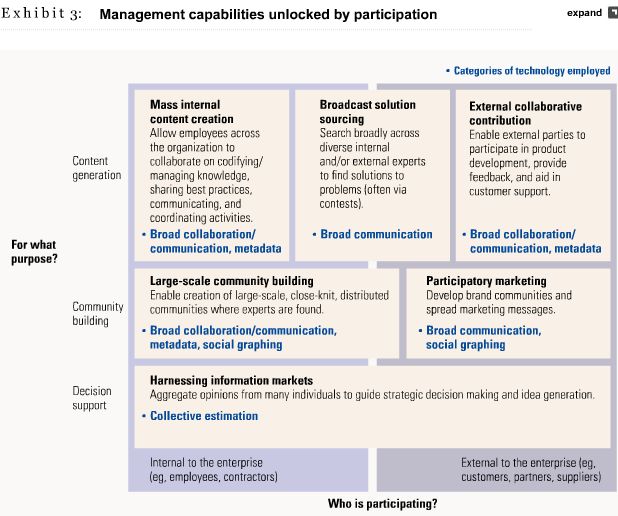
While I get the diagram below, it misses some of the high level B2B use cases, which is really all I care about as a B2B Product Marketing type, specifically Thought Leadership and Service.  Social media can increase personal, corporate and product visibility in the marketplace and improve service levels/customer satisfaction.   Perhaps the author rolled them under some of the other concepts, but the purpose of each should be a standalone set of metrics, goals and users.  With metrics as a challenge, the more you segment the use cases and owners of a use case the better you can gauge effectiveness of your social media efforts.
morphology

The artical did get the one thing really close to right:

The transformation to a bottom-up culture needs help from the top.

It is cultural, but it doesn’t involve the organization, it involves the emerging requirements of the workforce.   While today’s “I want my Facebook”, Bebo or Twitter in the workplace pleas seem somewhat trivial to some execs, these platforms are rapidly becoming the preferred collaboration tools for workers.  Risk considerations are often cited by many since these tools leverage not just internal expertise of an organization, but the networks of their employee and contractors.

It’s All About Risk

There is a time to embrace social media and a time to not, but I suspect the good outweighs the bad in the risk equation.  Risks: Perceived IP exposure, network security concerns or just plain slackerdom risk for some don’t outweigh the benefits, but the other choice for social workers is to use their personal iPhones or other PDA’s to accomplish the same tasks, only on slower connections and with less functionality.   What a drag, productivity drag that is…..for many folks social platform use is just HOW they work.

Access to answers, innovation and customers are just a click away, but only if your organization has a culture that provides access and encourages participation.

Now look at them yo-yo's, that's the way you do it
You play the guitar on that MTV
That ain't workin', that's the way you do it
Money for nothin' and your chicks for free
Now that ain't workin', that's the way you do it
Lemme tell ya, them guys ain't dumb
Maybe get a blister on your little finger
Maybe get a blister on your thumb
                                 -Dire Straits

Old School Marketing for Social Media Type Stuff

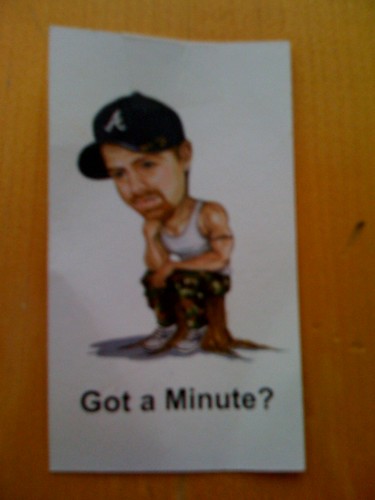
So I went to check the mail the other day and yet again some random person put something in my “please pick my mail, OH Mr. Attentive Postman Person flag”.    Normally all of the unwanted hang tags and cards go straight to the trash.   The main driver is these are typically for services I already have a vendor of choice for or I don’t need any trees trimmed, wouldn’t even imagine why painting my walls with toddlers/kids and I am pretty sure I don’t need any more Pampered Chef items, but this one was different – it was for a blog (http://www.theredneckreview.com/).  So I didn’t throw it away instead I took a photo and decided to write a little.

Promotion is Hard Work

photo.jpg

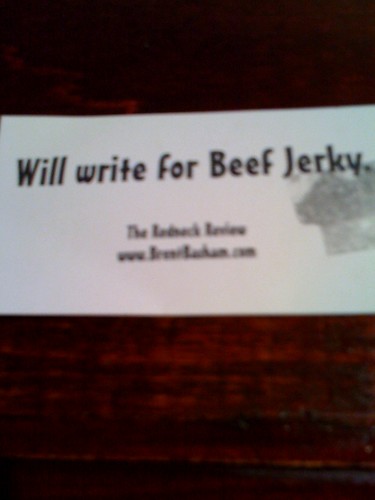
Who WOULDN’T give this sorry little cartoon character a minute and turn over the card, so I did on the way to the garbage can – stop not a service provider, a writer!  Come to find out it is a blogger, trying to sell his wares sorta door-to-door in a bad economy.  How bad?  Well apparently beef jerky bad.

photo.jpg by you.

In the end, social media isn’t killing old ways of doing things it is only changing how/where we do it.    As marketers, we will continue to create content, continue to advertise and we will continue to be challenged to covert interest into motivation to buy.   Buyers are people and the more you can touch them the better, so integrating your online channels with the real-world marketing is an imperative for your brand.   I know this is pretty self-evident, but I’m always a little amazed at how hard it is find a product’s website on their advertising and packaging, but Brent Basham gets it – no single channel is independent or works in today’s marketplace.

So a brand managers, find a way to get your online identity on packaging and all advertising.  As product owners we need to find a way to get your product’s story integrated into as many of the online activities/channels as possible.