Browsing Tag

product management

Betamax Wins! An interview with Jim Foxworthy

Are you new around here?  Spatially Relevant, not only is about sharing the things we find from cool people, but also sharing/identifying trends in marketing, branding and how product managers can change a business with technology, such as social media.  Stick around and add the rss feed to your reader or follow on twitter.  Now on to the article.


Ok, so those of you around long enough know this isn’t the case with Betamax and we are now all upgrading to that blue thing, but the important part is Beta.    If you have been around product management long enough you know that processes and methodologies come and go, but best practices stay the same.  In technology one of the perennial milestones is going Beta.  While a technical feedback loop, it more so a market feedback loop.   It’s this step in any process where most of us get just a little nervous with the launch process, but hopefully not if you had launch in your mind since concept.  So like most product managers, my technical background and experience historically saw the close of beta and launch as milestones, rather than an ongoing process which started with the market requirements.

After leveraging the folks at Pragmatic Marketing to understand best practices in product management for almost a decade, I’ve come to see launch as an integrated process which parallels most of the development.   So I was glad to hear they were adding dedicated course on launch to the training catalog and was SUPER excited to participate in the beta.

Yup, Pragmatic Marketing is launching a new course on Launch Essentials and I had the opportunity to beta it onsite with the whole team – Product Owners, Technical PM’s, MARCOM and Product Marketing.   During the day I was impressed not just by the content, but the beta engagement process.  By being part of the process I was able to learn new things and share feedback with the instructor, David Daniels, and Graham  Joyce which is the goal of any beta, but the structure and measurement of the feedback is integrated into the process real time for the Pragmatic team.   Just as with any beta process, the team was looking to ensure as they launched a “product” to market it which actually meets the needs of their target market.   During the 1 day workshop we addressed the typical problems/pitfalls in launching a technology product to market profitably and the team challenged the pragmatic folks on how to ensure our Agile processes and launch methodologies were synched from concept to launch.

So with a little extra access to the team, I decided to see if I could ask some questions of Jim Foxworthy, the VP of Product Marketing at Pragmatic Marketing and Jim was kind enough to participate, as you can see by the title of the post.    The goal of the interview below is to get some insights on their beta process and the types of folks they have in their business.    I have similar interviews of two other pragmatic folks (David Daniels & Steve Johnson) to read which validate the varied backgrounds and common view of successful product managers which are echoed below by Jim’s answers.

Many thanks to Jim and best of luck to the team on the launch of the new course, with the standardize beta process, measurement and market engagement I’m confident it will be a success!

Q. What Roles have you had in the industry prior to joining Pragmatic Marketing?

I started in technology in 1975, so the ‘roles’ list would be a bit boring and long! But suffice to say that I worked in IT shops until 1983 doing operations and some development, then independent vendors until 2001, then joined Pragmatic Marketing as an instructor. During my years with vendors, I did customer support, client training, sales, and product management.

By the way, not that you asked, but while carrying a sales quota was not the easiest gig for me, the experience paid big dividends. On occasion we get a laugh at the expense of our sales brethren, but knowing what it takes to close business made me a much more effective product manager.

In 2002, while continuing to teach for Pragmatic Marketing, I started a consulting practice focused exclusively on implementation of the Pragmatic Marketing Framework. Over the following five years I worked on nearly 100 implementations.

Q. As you were with the other companies did you use the framework in other roles?

I was a student the first time Pragmatic Marketing offered the “Practical Product Management” seminar in 1993. I had both successful and unsuccessful implementations of the Pragmatic Marketing Framework between 1993 and 2001. I prefer to think of my mistakes as ‘opportunities to learn’, but some of them were unpleasant!

Q. I recently participated in a Beta process with you and the team and it appears that you not only eat your own dog food, but have a tightly defined beta program, expectations of the participants and adjusting the product in response.  How is this different than you have worked beta programs previously?

Thanks for the compliment! Being the product manager here at Pragmatic Marketing doesn’t give me much latitude to ‘stray’ from what we teach. The other instructors are NOT shy when I do (smile)!

In many ways our Beta process is not that different from programs I have run in the past. Our ‘product’ is our seminar, and the source code is in (believe it or not!) MS-PowerPoint. So, when the ‘code’ begins to look pretty close to the requirements and the positioning (we do those, too) then we know it is time to get some market validation. Beta testing gives us that, plus one more thing that we cannot duplicate in the ‘development lab’ — real teaching time. There are some things about the delivery of seminars that you can -only- learn on your feet, working with a live audience.

Q. How are the emerging development agile methodologies impacting the framework or the way PM’s need to look at the market?

Agile development methodologies are having a big impact on product managers! New artifacts and job titles are emerging that can be confusing, and there is an enormous about of pressure to spend more and more time with development. Yet the need to discover and validate market problems has NOT changed. Pragmatic Marketing recently launched a new seminar titled, “Living in an Agile World” to address these very issues. (If I had my go-to-market hat on, then I would write) For more information, please go to www.pragmaticmarketing.com.

Don’t be a product management victim.

Josh has some good quotes and some good ideas. Good communication, cross functional engagement and clear plans are essential. The presentation conceptually represents the type of content you will find on his blog, A Random Jog, check him out.

I hope to get back to writing in the next week or so, just way too busy with travel and stuff. Excited about being in Chicago for the weekend, so those of you who will be at SOBCon. Cheers!

~jon

The 4 PM Confusion in Technology Companies

The names and questions that we get as a Product Manager are all other place from a title and role perspective.  However; answering the “just what is that you do again?” or the confirmations of what I do “Oh, you’re like a project manager, right?” are equally not as fun, which is something most Product Managers have to endure throughout their career.

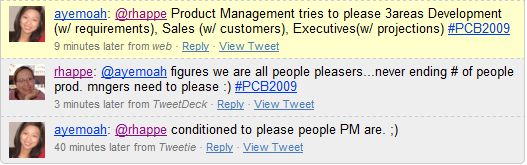
So we all end up describing what we do in non-traditional job descriptions, which may resonate with folks.   Doubt it?  Take a look at the tweets from ProductCampBoston.

productcamp

I’ve never considered myself a people pleaser, but corporate politician or favor trader works, which is not inconsistent with the Tweets above.  Ultimately the activities, ownership and accountability for PM’s is a difficult thing when a company has all 4 of the PM’s types – Product Managers, Product Marketing, Project Managers and Program Managers.  On any given product, project or initiative all 4 can be involved and ownership can be difficult to discern and each may have some level of conflicting goals/motivations, but that is have the fun of being a PM.   So I’ve been stuck on the 4 PM concept for like 2 weeks since I talked to a friend:

“We started a project the other day and it has a Project Manager, 2 Product Managers and 1 Product Marketing person and my boss is more worried about how the PMO office is going to report on it, rather than if we are doing the right thing” – Annoyed Program Manager.

Oh the right thing!  The right thing varies by job description and role, ownership, influence and visibility across the business.  So while I haven’t taken much issue with being introduced as a project manager, program manager or a product manager to clients, it’s mainly because in any given situation a product manager can be 1 or all of the roles.  I do know however that if dialed in correctly having all 4 roles can deliver good things for a business and a product. So figuring out what each person does is an important thing and may vary from project to project and release to release.

Dilbert.com

So I thought it might be a good time to put to paper a delta analysis of what a PM does of each iteration.

Project Manager: The Gantt Will Set You Free

Ever since Henry Gantt pioneered the controls, constructs and made a pretty chart with critical path diamonds, Project Managers (PM) have objectively been presenting slip risk, providing two sentence summaries and yellow/red/green bubbles to management teams everywhere.  Have MS Project can travel!  The reporting and task management realities of development, launches and organizational readiness require an attention to detail, lack of emotional investment and organizational balance which typically isn’t a core value for a Product Manager (PM).

The successful interaction of all PM’s with the Project Office is an imperative, since it is typically an agnostic group which is solely accountable for schedules, costs and trusted objectivity.  The best models are to have this as a standalone group.  Not all organizations have this type of functional independence, but they should.   I had a friend who once had the PMO in his PM group and let me tell you, that is a completely unfair organizational alignment for development and support, but a makes for a pretty cool Product Management time.

Dilbert.com

Product Management: Nebulous Interactions and Priority Juggling

While there is no patron saint of Product Management (PM) like Gantt for Project Managers, we do however have Dilbert and I’m OK with that.  I’m sure there is some developer somewhere is going to say Dilbert is theirs, but that just part of the life as a Product Manager.

Product Management is different in each organization, with different title lengths and varying levels of P&L influence/accountability.  Some are business owners and others manage requirements – some do all, while the common theme exist “You have to keep things going right way and manage priorities”.  PM’s are responsible for optimizing the cross functional interfaces, customer value and competitiveness of their product in the marketplace and that creates a bunch of Dilbert moments.  PM’s just dance around the organization and try to make things work.  In the more technical organizations these folks are constantly managing the delivery of IP to Product.

Dilbert.com

Program Manager: Strategic Managers of Stuff

Program Managers have the DNA of both the previously evaluated PM’s, not so much Product Marketing folk tho. These are link Project Management Ninja or pattern a matching Product Manager of strategic things.    Essentially a corporate tattletale of cross project collisions and the celebratory target for things that randomly align.   This is a great gig for project managers and product managers alike – especially if you get organizational resource influence.  Actually it could quite possibly be a really good gig with the right company: organization switching, cross product reporting and interfacing with strategic clients/executives.  There is significant risk of incremental sport coat requirements in this role.

While there are at least 1000 product managers at Microsoft, who each admittedly have a tough time articulating their role in the Borg, the MSFT program managers readily admit that “Dude – I got a sweet gig!” and have a REALLY hard time explaining what they do.  It might help just to understand the difference in a program and a project:

1. A project is unique and is of definite duration. A program is ongoing and implemented within a business to consistently achieve certain results for the business. A project is designed to deliver an output or deliverable and its success will be in terms of delivering the right output at the right time and to the right cost.
2. Program management includes management of projects which, together, improve the performance of the organization. A program’s success will be measured in terms of benefits.
3. Benefits are the measures of improvement of an organization and might include increased income, increased profits, decreased costs, reduced wastage or environmental damage, more satisfied customers. In central or local government organizations, benefits might include providing a better service to the community.
4. In the course of achieving required results, business programs will normally understand related business constraints and determine the processes required to achieve results based on resources allocated. Improvement of processes is a continuous operation that very much contrasts a program from a project.
5. At the lowest level project managers co-ordinate individual projects. They are overseen by the program manager who accounts to the program sponsor (or board).

I kinda see it like being a “cross-thing” corporate gardener and really similar to the other PM’s – the only difference is scope and lack of titles about director.

Dilbert.com

Product Marketing: Go to Market Magic

Product Managers (PM), not unlike program managers, are responsible for the random alignment of product goals and revenue optimization.   The right story, the right capabilities and the marketing mix are essentially the domain of Product Marketing folk.  Moderately good excel and PowerPoint skills are essential.   These folks are the organizational sanity check on a given product or set of products.  Sales enablement, product level brand connection and consumable stories which drives revenue and reduces cost.  For most organization’s being a PM is like being a Product Manager minus product delivery.

Dilbert.com

No matter where your company is in the 4PM model, all you need is a little trust and experience to make it work.  Detailed job descriptions help too, especially if you have all four.

Maybe I should have just tried to explain the roles by the core apps they use:

  • MSFT Project + PowerPoint + Intranet Project Status Site = Project Manager
  • PowerPoint + Email = Program Manager
  • PowerPoint + Email + Excel + Software Lifecycle App = Product Manager
  • PowerPoint + Email + Excel + Adobe = Product Marketing

New Here?

In general I blog about technology, music and marketing. Not necessarily in that order. Add me to your reader or subscribe view email.

OR your can add me on Twitter

cheers! ~jon