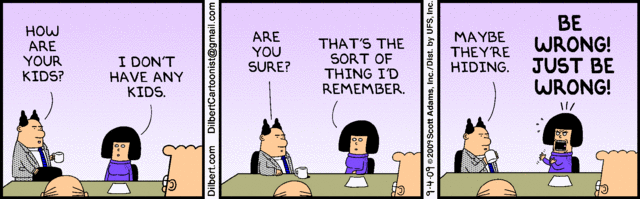
OK, maybe I have, but I’ve always liked the customer and the value they bring to the business or product. Sometimes users are just a little distracting, but a necessary distraction if you are going to be successful in the marketplace, you can’t just care about the decision makers and economic buyer.
The persona approach from Mulder Media in this presentation is spot on from analytical perspective. Most persona are not based on data and Mulder’s presentation helps identify how to prioritize and segment your personas in the process of building products and execution/developing a strategy. Different persona’s for different needs.
Ultimately we do thing for users AND the business as product managers, so we need to leverage facts and opinions in a way that supports our users needs and wants for a product to ensure adoption and continued satisfaction with the product and the business. Personas help with this and just might be the only way to effectively convey this throughout the development lifecycle and in your go-to-market strategy.
Two reasons: it’s simply irrelevant to them at the scale they operate on and there’s no upside to it. I hate to admit it, but I was link-baited into reading a Slideshare presentation entitled CEOs and Social Media – A Look at the Fortune 100 CEOs and their Online Image and Communications. I’ve embedded the entire presentation below so you can take a look at it as well. The presentation was developed by ÜBERCEO, a blog that “follows, comments, reports and discusses everying (sic) about the CEOs who influence the business world. Unlike other CEO blogs and websites that offer tools and information for CEOs, ÜBERCEO is about CEOs.” The fact that the authors of the blog can’t get the spelling right on their About Us page is a clue to the quality of thinking you’ll find in the presentation.
Part of my work these days is researching the monetization of social media. Needless to say I was looking forward to some insights about social media in the largest corporations in the world. Regrettably, I was disappointed by the shallow analysis contained in the presentation. I think I can sum up the entire presentation with the following quotes:
“CEOs are Laggards in Social Media. We looked at the country’s top 100 CEOs and found that most are sorely lacking in social media exposure, connection or conversations: – Only two have Twitter accounts. – 13 have LinkedIn profiles, and of those only three have more than 10 connections. – 81% don’t have a personal Facebook page. – Almost a quarter have no Wikipedia entry – 31% of those that do have limited or outdated information. – Not one Fortune 100 CEO blogs”
“The country’s leading CEOs aren’t anywhere near as connected as their employees, partners, executives and customers are likely to be. They’re simply not communicating in the same way. It gives the impression that those CEOs are distant, disinterested and disengaged.”
“The question is not whether CEOs can use social media tools, but rather if they should… and if so, how and when”
I applaud the authors taking a fact-based approach to their research. Over a couple of week period they diligently scoured Twitter, LinkedIn, Facebook, and Wikipedia for evidence of Fortune 100 CEO’s online activity. I cringe, however, at the relatively naiveté of their conclusions. I am fortunate, I guess, to have met a few Fortune 100 CEOs (courtesy of my father who was a senior executive of a Fortune 10 firm for many years). It’s pretty clear that the authors of this piece may never have been in the same ZIP code, much less in touch with such CEOs.
Fortune 100 companies, by definition, are the largest companies in the country. In 2008 the Fortune 100 generated $6.58 trillion dollars of revenue and $238 billion of profits. The latest data from the 2007 Economic Census stated that there were 14,436,874 establishments that generated $57.7 trillion dollars in revenue. In other words, 0.00069% of the companies (Fortune 100) generated over 11.4% of all revenues.
The value of a Fortune 100 CEO’s time is hard to put in perspective. One way to look at their value is how much revenue and profit their firms generated, on average, every minute of every day in the year.
The largest company in the Fortune 100 generated over $14,000 a minute in revenue and over $1,400 in profit. A typically decent sized company that generates $1 billiona year in revenue only produces about $31 in revenue and a $2.38in profit per minute. One could infer that a minute of time of a Fortune 100 CEO is significantly more valuable than that of a typical $100 million CEO. Now this isn’t necessarily an accurate metric or tool, but at least it provides some indication about the relative impact of how a CEO chooses to invest his or her time.
The primary reason Fortune 100 CEOs don’t participate in social media is that there is no real benefit for them. Their firms have already pretty much reached the pinnacle of their industries. In fact, what those CEOs crave more than anything else is anonymity. The last thing they need is to be deluged with direct messages, @replies, or Facebook messages. The biggest challenge they face is deciding where and how to invest their time.
For the CEOs of the other 14,436,774 companies in America, however, social media is definitely a strategy that can help drive growth and create value. A classic example is Zappos.com, the online shoe retailer. In ten years Zappos has gone from $0 to over $1 billion in revenues. Zappos’ CEO Tony Hsieh has woven social media into the fabric of his company. There are a lot of factors that have driven Zappos’ success but social media has been a critical element.
If it takes two minutes to draft a witty Tweet one might infer that such an investment in time would cost Rex Tillerson, the CEO of Exxon Mobil the opportunity to create $28,000 in revenue and $2,800 in profit. The same tweet might cost Tony Hsieh $60 in revenue opportunity. Since Tony joined Twitter in June 2007 he’s posted 1,725 tweets and Zappos’ revenues have grown from $840 million to $1 billion. At $60/tweet that’s about $103,000 in ‘revenue opportunity cost’ to generate $160 million in new revenues. Now Zappos revenue growth was driven by its superior service, products, and employees. Tweeting played a very small role in it. One can’t deny, however, that Zappos’ entire approach to leveraging social media has played an important role in their growth.
As promised, here’s the full presentation from UberCEO. It appears that after publishing this preso, they did a much slicker graphically oriented one that I’ve included as well. That one has an even better link-bait title “Fortune 100 CEOs Are Social Media Slackers”
So I’m glad to be back from a 18 day run in Europe and I finally have a little “down time” to finish a post which has been in the drafts status since early August. With the end of quarter crunch that is all too common in software, I decided that I needed to move this post from draft to published now!
So I was listening to The Bert Show about a month or so ago and they had some clips on a debunked psychic which was fairly entertaining and I realized this could be a fairly interesting way to look at leadership. Ultimately this is a continuation of a series on Leadership personas which began two years ago – Stuck in the Middle. The series started mainly out of a series of observations from folks I had worked with over the years and a couple of traits I saw in myself even made into a couple of the personas.
The latest persona, The Colder Reader, is one of those people you run into who skeptics, such as myself, just kind of sit back, shake your head and generally ignore, but that is not the reaction for everyone. Everyone has a dream and a soft spot and the Cold Reader is good at sifting through his or her laundry list of generalizations to figure these out.
Where some people wish for things to be different and long for a different reality in an organization, the Cold Reader is a great novelty for an organization – at least for the first 9 months in a role, even for the skeptics – it provides for great “can you believe X thinks this is a good idea” discussions and provides for an interesting betting pool on “When are they going to fire the Cold Reader”.
HINT: It’s always longer than you think, because people generally always want to be doing something different and there is always someone misdirect blame to.
So what is cold reading anyhow:
Cold reading is a series of techniques used by mentalists, illusionists, fortune tellers, psychics, and mediums to determine or express details about another person, often in order to convince them that the reader knows much more about a subject than they actually do.Without prior knowledge of a person, a practiced cold reader can still quickly obtain a great deal of information about the subject by analyzing the person’s body language, age, clothing or fashion, hairstyle, gender, sexual orientation, religion, race or ethnicity, level of education, manner of speech, place of origin, etc. Cold readers commonly employ high probability guesses about the subject, quickly picking up on signals from their subjects as to whether their guesses are in the right direction or not, and then emphasizing and reinforcing any chance connections the subjects acknowledge while quickly moving on from missed guesses.
So just like psychics who engage in a “vague but true” series of assertions and follow up tactics so does the Cold Reader.
If you spend enough time with generalities with a person/individual contributor/fellow executive they will give tells/queues for when your on the right track. The Cold Reader is a leader who uses career aspiration queues, optimistic short comings and people’s plain desire for something to be true to his or her advantage through a series of quick spun powerpoint decks and point quotes from analyst to validate their assertions and directional strategies.
CEO’s, VP, Directors and just about every station in corporations have folks looking for a little insight and are more than receptive to provide personal directional goals and organizational challenges in fairly short order – after all, that is how people collaboratively problems solve.
Executive Cold Readers often leverage small focus groups of smart folks in the organization to gain content, input and new slides which are then played back over time to slightly larger groups until he or she thinks they have the story right. Ultimately every one wants a good story and wants to be part of the solution – right? Plus the Cold Ready is always up for a roadshow, who doesn’t want a couple of days in SFO and Southern Cali after all.
Think of the air miles one can garner with new slides every quarter, million miler baby!
So at the end of the day everyone does like a good story, right up until the story is all about investment and patience….. The typical types of discussions:
Scenario 1: VP of Sales is not getting the traction in the marketplace with the story and the Cold Reader is the Marketing Executive.
Cold Reader: So what is the biggest challenge with moving these deals through the pipeline?
VP of Sales: The story is just isn’t resonating with the reps or the prospects.
Cold Reader: Are there any reps which are seeing traction?
VP of Sales: Yeah, Geoffry and Augustine are moving things forward on several big deals.
Cold Reader: I’ve always liked Geoff and Augustine, strategic salespeople who understand solutions our solutions. Well, should we focus on training and skills for the rest?
VP of Sales: Sure we need more training and there are upgrade opportunities in the staff, but we really need something different that scales in the field and resonates with prospects who have problems and buy products.
Cold Reader: I hear you on building a more strategic sales force, rather than trying to train up the more tactical team members who don’t get it. I’ll put together a project on packaging with everyone and we may still want to consider upgrading the team to be more stategic.
Result: VP of Sales leaves the meeting thinking the colder reader has an action plan and everything is going right way, but in fact the Cold Reader goes to edit PowerPoints based on the discussion and begins socializing the latest version of the PowerPoint strategy.
Scenario 2: The CEO and the Cold Reader are having an ad-hoc discussion on the business, project status and general how are you doing stuff. The Cold Reader in this scenario is a development executive.
CEO: So what’s going on? We’ve missed another launch date and can’t seem to get traction with our products lately, thoughts?
Cold Reader: Well we are producing really solid technology and I’m not quite sure about market uptake on the products, but the pipeline appears strong. Things are going great in my group right now, we’ve implemented new processes and are improving our delivery cadence which will clearly help the product management team in release planning.
CEO: I know we have done a bunch of work in improving our processes, but that doesn’t mean shit if we aren’t moving product that sells. I’m very cool with improvements, but processes aren’t driving revenue and it appears that it is actually increasing costs according Kevin’s analysis.
Cold Reader: Kevin’s analysis while interesting doesn’t take into account the increased development velocity and quality, but that’s not what we have CFO’s for anywho. Ultimately we should look at prioritizing our development efforts against emerging opportunities and the current backlog of stuff per my team is mainly focused on improving our existing customers profitability, minimizing attrition, and add-on transactions which aren’t really going to grow the company.
CEO: Dude your right, we need think about growing the company by doing other stuff. This marketplace is more or less steady state and all we are doing is carving out customers from competitors. I like a good fight, but it gets old after awhile being a commodity.
Cold Reader: My team has seen some interesting trends around SOA and Analytics in the space which could generate some upside, but these aren’t the requirements we are getting to work on.
CEO: Yeah what we need is some sizzle and new acronyms. I read about SOA on the plane the other day and it seems like the newest cool shit faster, so you might have something here. Analytics will provide a little sizzle too.
Cold Reader: We have some items in the backlog, but the product group is prioritizing some product add-ons which are focused on incremental revenue and competitiveness in our current segment higher. If we could align our backlog to your vision we might be able to make some hay in the marketplace. I also read something somewhere about these technologies being differentiators and high growth market segments which could really change the company like you want to.
Result: CEO has a summit with the marketing group and recommends they look at re-prioritizing some of their items around this SOA stuff and Analytics sizzle that would make the company more relevant and key revenue wedge items are discarded.
So the Cold Reader in the right corporate environment can have a good time, hell some psychics even get their own TV shows, so there something to be said about that. In principle, a Colder Reader’s answer after listening and leading the folks being read is “put me in charge” and just with any new gig there are always low hanging fruit to address and declare a victory that’s why you should bet 24 months or greater typically in the executive dead pool.
The Cold Reader kinda starts to see his or her future in a mid-year Ops review which goes a little like the video below…
…and the person is just a little amazed it’s not working and that they don’t have an angle play. At the end of the day, you can’t think ill of those that want to believe in something better…
Let me see if I can do some cold reading…
Dear Cold Reader,
I’m thinking you recently updated your LinkedIn Profile with inaccurate information/titles. Something about COO/CIO… I’m sensing a “somewhat outmoded” executive team will received a full bonus payout and I’m going to get a bunch of $5 dollar payments in the mail or free lunches over the next quarter.
Brand spend, brand awareness is so different today than even 12 months ago thanks to the interwebs and an increasingly over burdened attention span. Crowdsourcing, multi-tasking and interactive media preferences require a different approach, since as noted in Helge Tennø‘s presentation the internet is a connection machine!