Browsing Category

Product Marketing

Twittered – Now what?

Twitter

So I’ve setup my twitter account and am getting used to this whole thing.  At this point I think it’s about weather, but I suspect that will change over time as I get more comfortable.

I also think twitter is one of those words and potentially [tag]brand[/tag]s which can be a verb, a noun and an adjective – great opportunity for them.

So as part of this ongoing experiment of blogging I’ve added Twitter to the mix, I’m meeting randoms and getting feedback, which ultimately will make me better at the whole thing.  I think by the end of the week [tag]twitter[/tag] may be the most interesting tool yet for getting submersed in this whole [tag]social media[/tag] thing.

So how does one effectively use twitter? Ideas or recommendations?   I think I need an iPhone and a new Mac to get the WHOLE experience.  Don’t get me wrong, at least I’ve already put stickers on my laptop.

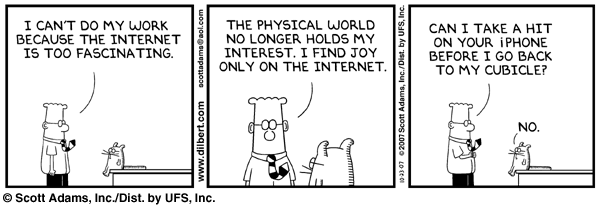
So a friend sent me the Dilbet below:

Dilbert - Social Media Addition

So what do you do?

A relevant feed: Feedhub

So I have found a new widget, I not a widget guy- but I like [tag]Feedhub[/tag].  This is yet another opportunity to stay in touch with things of importance.  Feedhub claims, at least I have it configured to, only show “interesting” posts.  I’m only 3 days into the process so let’s see.  I think since I have it on my blog, it might learn from all of us.  So while personal brand and limit widget usage is key, as noted by Chris, this is our little social experiment.

Gosh I hope I understand how it works, so take a look at the widget on the right called relevant feed and see if it tweaks it’s content overtime – know of any good feeds?

Did Morgan Spurlock Damage the McDonald’s brand?

I remember with great joy and glee when I would request going to McDonald’s during my early childhood and I clearly remember it meant anything – [tag]Arby’s[/tag], [tag]Burger King[/tag], [tag]KFC[/tag] or [tag]Wendy’s[/tag] – just fast food please. I also think I remember this word usage in college, but it doesn’t seem to be the case today in casual conversation. This may not even be a reasonable observation by the extremely focused group of folks I interact with, which are effectively 30+ yrs old for the most part.

So the question I have is – Has the McDonald’s brand been permanently damaged for the 30 somethings due to [tag]Morgan Spurlock[/tag]? This question came about due to another post I made on Culinary Gizmodo:

So we all like McDonald’s, most will probably not admit it and seldom not feel guilty after a visit – but we DO like McDonald’s. All of us have new way of referring to a quick stop as Micky D’s. Ever since the movie Super Size Me from Morgan Spurlock we refer to McDonald’s with euphemisms: “grabbing something quick” or “getting a burger”

I’m not saying we never admit we eat at McDonald’s, but if we do the admission somehow includes a salad and Dasani. I think many of use say fast food instead of McDonald’s as well.  So my hypothesis is that at some point since [tag]Super Size Me[/tag] in 2004, Morgan’s work could quite possibly have demoted the McDonald’s brand to a less than synonym status of the like of Coke or Kleenex.

The other option is that Spurlock didn’t erode the brand and my cohort group just isn’t a naturally strong demographic. Thoughts?

Top 5 Email tips: Captain Obvious Content Around Effective Spamming

So here is some content I lifted from some site, but only for the purpose of writing against as a framework. My apologies, I didn’t source in my [tag]notepad[/tag] file. Regardless, I cut-n-pasted this mainly because of the KISS method, [tag]Keep it simple stupid[/tag].

While a methodology I embrace, this list is like DUH! Clearly Captain Obvious content. I have inline comments in italics. Maybe it’s a good idea I didn’t source this [tag]Top 5 Email Tips[/tag], which started as a [tag]Top 10[/tag] which I cut up.

1. Understand your readers

Like any media, make sure that you provide your readers with the information they want. This will improve the click-through rates and encourage people to read your next newsletter rather then select the “unsubscribe” link.

So knowing your target market, buyer and relevant content is normally a good idea.

2. Personalise

Practice shows that personalised content produces the best results, with better open- and read-rates compared with the one size fits all approach.

By personalise, they clearly mean something like using their first name from a data based. The bad news is the sales person spelled it wrong, your CS rep didn’t get the name or just put in the first initial,

I’m actually a generic fan unless you KNOW the data is right or owned by the user, then it’s their fault that Steven became Setvne.

3. Do not leave an empty Subject line

Most empty Subject lines get spammed so make sure you don’t leave it empty or your email won’t get past spam filters.

Typically you don’t write someone unless there is a subject for the note – right?

4. Do not use deceptive Subject lines

The Subject line should pertain to the email and be informative enough to encourage the reader to open it whilst not being too long. It should not be in capitals, or contain exclamation marks.

Deception is not a good idea on ANYTHING OK!?!?!?!?!!!!!!!

5. Clear From lines

The From line should clearly state your company’s name or your name. Avoid spam From lines such as “Message from a friend” that are being used quite a lot by spammers.

Who really ever sends a message from a friend?!?!?! Well I did get a note from the secretary of finance in Nigeria, who apparently had an urgent message as a friend.

So as a basic promotional framework, it’s always good to remember that honesty, urgency, relevance and a reason to read is a good idea… This whole [tag]SEO[/tag] and [tag]SEM[/tag] thing continues to create lightweight content which continues to clutter online search.

That’s why I’m more and more interested in human oriented/user generated content sources such as wikis for reference information, rather than blind search.